“Did you give it to him?”
“Of course not,” Hale said. “I told him it was classified under the highest level of national security, and that any further inquiries would result in a formal audit of his firm’s defense contracts.”
I laughed, a warm, genuine sound that felt good after the high-pressure survival of the last twelve hours.
“That probably gave him a minor heart attack,” I said.
“He’s waiting for you at the club,” Hale said, looking out the window as the green fields of Ohio began to appear beneath the clouds. “He’s throwing a dinner party for Nathan’s promotion tonight. He’s invited all his partners. And he’s made sure there’s an empty chair at the head of the table for you.”
I looked down at my flight wings, the silver metal polished and clean once more.
“Well,” I said, my voice dropping to a quiet, firm register. “I wouldn’t want to keep the youngest regional vice president in company history waiting.”
The Briarwood Country Club was illuminated like a palace when my taxi pulled up that evening.
The parking lot was filled with luxury German sedans, sports cars, and the occasional classic car—the physical manifestations of Columbus’s old money. The air was cool, carrying the scent of cut grass and expensive woodsmoke from the outdoor fire pits.
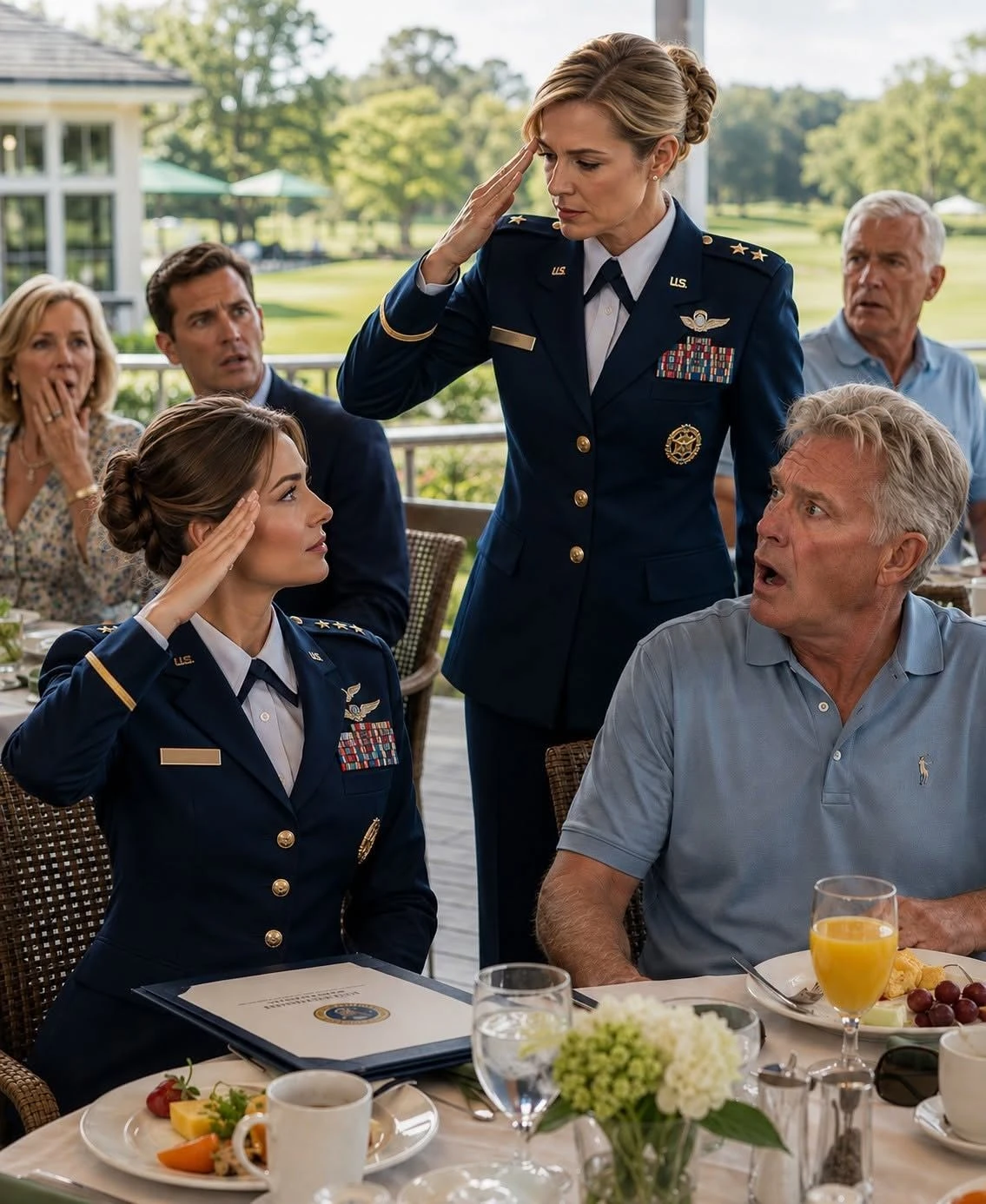
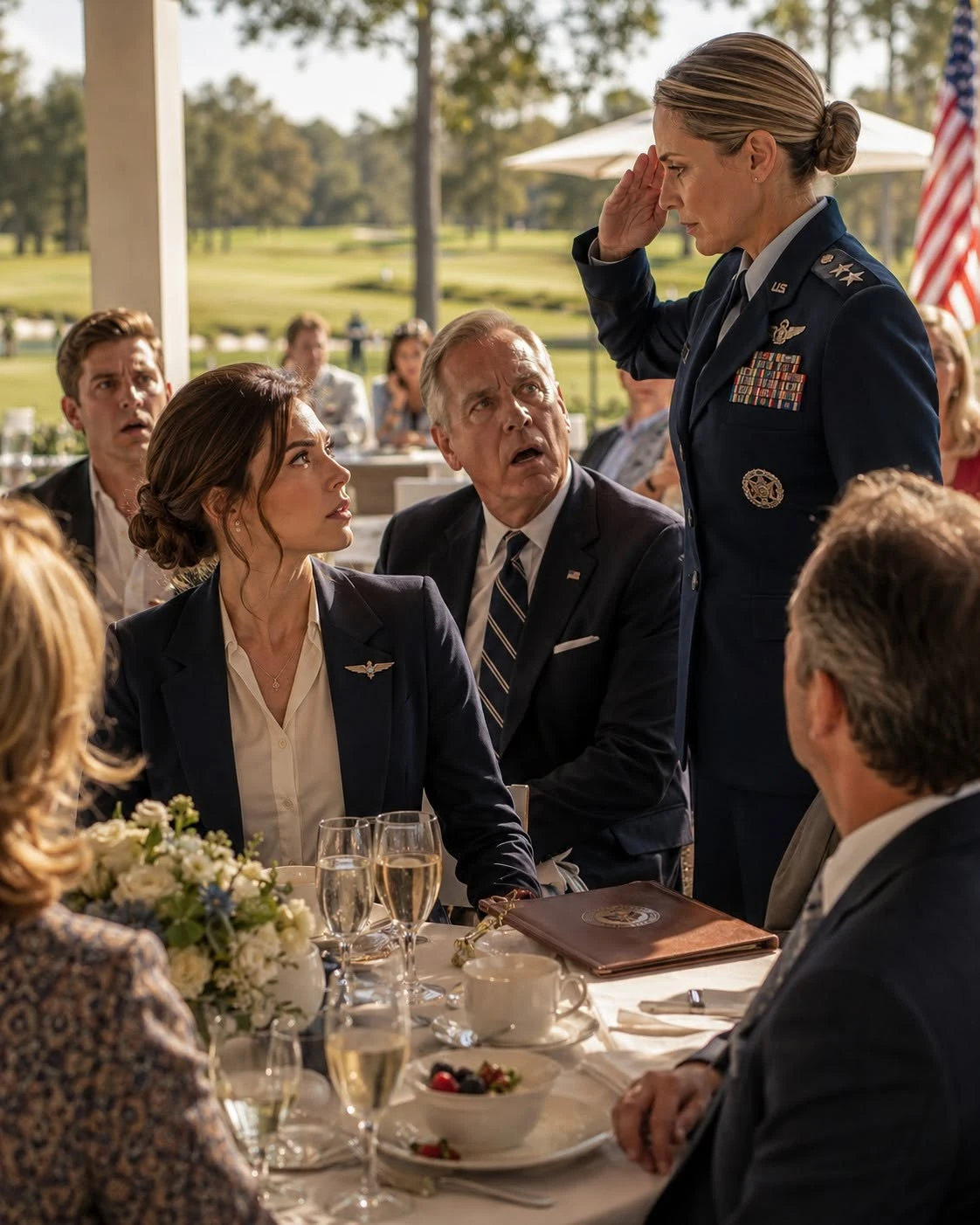
I walked through the double oak doors of the main entrance, wearing my service dress uniform.
The dark blue wool was immaculate, the four silver stripes of a Colonel gleaming on my sleeves. My chest was decorated with my full ribbon rack—the Distinguished Flying Cross, the Meritorious Service Medal, and the National Defense Service Medal—capped by the silver flight surgeon wings that had caused so much confusion that morning.
The dining room was crowded, filled with seventy or eighty people in tuxedos and evening gowns.
At the center of the room sat the head table. My father, Gordon, was in his element, wearing a custom-tailored tuxedo, a glass of champagne in his hand as he laughed with his senior partners. Nathan sat beside him, looking smug and self-satisfied, while my mother chatted politely with the wife of the local bank president.
As I stepped into the room, the conversations began to die down.
It wasn’t a sudden, dramatic silence like the one on the patio that morning. It was a gradual, rolling wave of recognition, people nudging each other, pointing at the woman in the high-ranking military uniform who had just walked through the door.
My father turned, his smile freezing as he saw me.
“Claire,” he said, standing up and smoothing his jacket. “You… you made it. We were beginning to think you wouldn’t show up.”
“I had a prior engagement, Dad,” I said, walking toward the table with a slow, measured stride.
The guests nearest the table fell silent, their eyes tracking my uniform.
“Claire,” Nathan said, his voice carrying a nervous, defensive edge. “Where’s… where’s that general woman? The one who was here this morning?”
“General Hale is back at the base,” I said, stopping at the end of the table. “She has an air force to run.”
“Right, right,” my father said, trying to regain his footing, to assert his dominance over the room. He raised his glass, looking around at his partners. “Well, everyone, as you can see, my daughter Claire has decided to join us. She’s… well, she’s made quite a name for herself in the service. Some kind of administrative colonel. Very impressive.”
The partners nodded politely, but their eyes were fixed on my ribbon rack. They weren’t stupid; they knew what those medals meant.
Suddenly, the heavy oak doors of the dining room were thrown open once more.
Two men walked in, wearing dark, identical suits with small, silver lapel pins. They didn’t look like guests. They had the hard, clinical posture of federal agents, their eyes scanning the room before they stepped aside to allow a third man to enter.
Director Aaron Vance.
He was wearing a black tuxedo that probably cost more than my father’s Cadillac. His face was cold, his eyes scanning the crowd until they landed on our table.
My father’s breath hitched. He knew who Vance was. His firm had been trying to secure a meeting with the DIA director for three years to secure a multi-million-dollar defense consultation contract.
“Director Vance,” my father said, his voice suddenly eager, his hands smoothing his lapel as he stepped out from behind the table. “What an honor. I… I didn’t realize you were in Columbus. Gordon Whitmore, senior partner at—”
Vance walked past him. He didn’t shake my father’s hand. He didn’t even look at him.
He stopped directly in front of me, his eyes softening slightly as he looked at my uniform.
“Colonel Whitmore,” Vance said, his voice carrying clearly across the silent dining room. “I wanted to personally deliver the President’s message. The citation for your Distinguished Service Medal has been signed. The formal ceremony will be held at the Pentagon next Friday.”
He reached into his pocket and pulled out a small, velvet-lined box, opening it to reveal the gold and blue medal resting inside.
“For extraordinary heroism and clinical brilliance under extreme atmospheric conditions,” Vance read, his voice ringing with a deep, professional respect. “You saved the life of a vital national asset. The country is in your debt.”
The dining room went completely, utterly silent.
My father’s hand, still extended for the handshake Vance had ignored, slowly fell to his side. His face had gone through three distinct shades of pale before settling on a dull, ash-grey.
“Claire…” he whispered, his voice trembling. “The… the President?”
I looked at him, then at Nathan, whose glass of champagne was shaking so violently the liquid was spilling over his fingers.
“I told you, Dad,” I said, my voice quiet but carrying the force of a sonic boom. “I don’t give flu shots.”
The silence in the grand dining hall persisted for what felt like an eternity.
Nathan was the first to try and break it. His voice, usually so filled with the smooth, practiced cadence of a young executive who had never faced a real obstacle, was thin and brittle.
“Director Vance,” Nathan stammered, stepping forward. “Perhaps… perhaps there’s been some confusion. I’m Nathan Whitmore. I was just promoted to Regional Vice President at—”
Vance turned his head, his gaze cold and calculating. He looked at Nathan the way a biologist might examine an unremarkable specimen of mold under a microscope.
“I know who you are, Mr. Whitmore,” Vance said, his voice flat. “Your company handles regional logistics for civilian supply chains. It’s… respectable work. For a civilian.”
He paused, letting the word *civilian* hang in the air like an indictment.
“But your sister’s team,” Vance continued, turning back to me, “is currently the only reason the United States retains operational dominance over the western orbital corridor. Her medical protocols are classified under the same national security directives as our nuclear launch codes. So when I see you, or your father, dismiss her achievements because she doesn’t carry a corporate title, I am left… unimpressed.”
Dennis Walker, my father’s retired investment broker friend, let out a low, dry chuckle from the edge of the table. He was a man who had made his fortune by recognizing real value before anyone else, and he clearly enjoyed watching the Whitmore family hierarchy shatter in real-time.
“Gordon,” Dennis said, raising his glass toward me. “It seems you’ve been boasting about the wrong child.”
My mother sat down slowly, her fingers trembling as she placed her glass on the table. “Claire… why didn’t you tell us? Why did you let us think you were just…”
“Because you never asked, Mom,” I said gently. “Every time I tried to talk about my training, or my research, Dad would interrupt to talk about Nathan’s high school golf score. When I completed my residency at Cook County, you sent me a card congratulations on ‘finishing school.’ You didn’t want to know. It was easier to keep me in the little box you built for me.”
My father looked around the room. He could see his partners—men he had dominated for decades with his loud voice and his wealth—watching him with a mixture of amusement and pity. His reputation as the patriarch of Columbus’s most successful family was dissolving right in front of them.
“Claire,” he said, his voice dropping to a low, desperate plea. “Please. Let’s step outside. Let’s discuss this in the private lounge.”
“There’s nothing to discuss, Dad,” I said. “I have a flight back to Edwards in two hours. I only came tonight to return something of yours.”
I reached into my purse and pulled out a small, plastic card.
It was the secondary member card for the Briarwood Country Club—the one he had given me ten years ago, telling me it was a “privilege” he expected me to earn by attending their social events.
I laid it on the table next to the velvet box containing my Distinguished Service Medal.
“I don’t think I’ll be needing this anymore,” I said. “The air is a lot cleaner at ninety thousand feet.”
I turned to Director Vance. “Shall we go, Director? The transport is waiting.”
“After you, Colonel,” Vance said, stepping back to let me lead the way.
As we walked out of the room, the crowd parted for me like the Red Sea, their faces filled with a sudden, intense respect that had nothing to do with my father’s money or my brother’s corporate title.
Behind us, I heard my mother start to cry, a quiet, soft sound that was swallowed by the rustle of silk and the murmur of sixty people who had just realized that the most important person in the room had just left it.
The drive back to Wright-Patterson Air Force Base was conducted in a different kind of vehicle—a militarized transport helicopter, an HH-60G Pave Hawk, which had landed on the secure pad at the local reserve center to pick us up.
The interior was loud, the twin engines screaming as we rose into the dark Ohio night, the lights of Columbus shrinking into a small, glittering grid below us.
I adjusted my headset, looking across the cabin at Director Vance.
“You didn’t have to do that tonight, Director,” I said over the intercom. “The medal was enough. The scene at the club… it was a bit dramatic.”
Vance smiled, a rare, genuine expression that transformed his stern face.
“My department is responsible for intelligence, Colonel,” he said. “And sometimes, the most effective intelligence operations are the ones that target domestic ignorance. Your father’s firm has been trying to get their hands on our logistics contracts for years. I wanted to make sure they understood exactly who they were dealing with.”
“You’re going to deny their contracts?”
“I’m going to subject them to a level of security auditing that will make them wish they had never heard the word ‘defense,'” Vance said coldly. “Nobody treats my son’s life-saver like a second-class citizen. Not even her own family.”
I looked out the window, watching the dark, rolling hills of Ohio slide past beneath us.
For the first time in my life, I felt a deep, profound sense of closure. The need to prove myself to my father, the constant, exhausting search for his approval that had driven me through medical school, through the grueling physical trials of the aerospace medicine pipeline, had simply… evaporated.
I didn’t need his validation. I had the stars.
“What’s the status on Commander Vance?” I asked, shifting my focus back to the only thing that actually mattered.
“He’s stable,” Vance said, his expression softening once more. “They’ve transferred him to the hyperbaric unit at Travis AFB. The doctors say his neurological scans are completely clear. No permanent tissue damage. He’ll be back on flight status within six months.”
“Good,” I said, leaning my head back against the nylon seating of the helicopter. “Tell him he owes me a bottle of high-altitude oxygen. The good stuff.”
Vance laughed. “I’ll make sure he delivers it personally.”
The Pave Hawk angled downward, the massive runways of Wright-Patterson appearing ahead, illuminated by high-intensity green and white searchlights. Below us, a team of ground crew was already preparing a C-17 Globemaster for our return flight to California.
My work wasn’t finished. The *Aegis* program was expanding, and there were more crews preparing to cross the boundary into orbit. They needed medical protocols. They needed zero-G surgical systems.
They needed their Colonel.
The morning sun was just beginning to touch the desert hills around Edwards Air Force Base when I stepped out of the transport terminal.
The air was dry, hot, and smelled of jet fuel—the signature scent of my real home.
I walked toward the medical research complex, my boots clicking on the concrete. Ahead, a tall, familiar figure was standing near the entrance, leaning against a jeep.
Lieutenant Colonel Jack “Apex” Mercer.
He was holding two paper cups of hot coffee, a wide, predatory grin on his face as he saw me approach.
“Hey, Colonel,” Jack said, handing me one of the cups. “I hear you had a pretty wild dinner party in Ohio.”
“Word travels fast,” I said, taking a sip of the strong, bitter coffee.
“Vance’s detail was talking about it on the secure channel,” Jack said, laughing. “They said your old man looked like he’d just eaten a live hornet.”
“He’ll survive,” I said, looking up at the sky.
High above us, barely visible in the bright, blue light of the morning, a thin, white contrail was drawing a line across the heavens—a high-altitude research flight testing the limits of human engineering.
“You ready to get back to work, Claire?” Jack asked, his tone turning serious as he looked at the medical complex. “We’ve got the next launch window in forty-eight hours.”
“I’m ready, Jack,” I said, pulling my sunglasses down over my eyes. “Let’s go see what the sky has for us today.”
As we walked into the building, the heavy steel doors closing behind us with a familiar, pressurized hiss, I knew that the world of Briarwood Country Club, of my father’s petty snobbery and Nathan’s empty executive titles, was nothing but a distant, fading signal on my radar.
I was a flight surgeon. I belonged to the horizon.
Six months later, the dry heat of Edwards Air Force Base had been replaced by the crisp, biting wind of late autumn.
The medical research complex had expanded. A new, massive hangar had been constructed at the edge of the secure testing area, its doors painted with the insignia of the **USSF ORBITAL MEDICINE AND RECOVERY SQUADRON**.
I stood on the glass-walled observation deck overlooking the training pool—a million-gallon neutral buoyancy tank designed to simulate the weightless conditions of low Earth orbit.
Below me, four trainees in bulky, white pressurized suits were struggling to perform a simulated vascular reconstruction on a high-fidelity medical mannequin. The mannequin was floating inside a mock-up of the *Aegis* cockpit, its synthetic arteries spraying colored water into the clear pool to simulate zero-G arterial bleeding.
“Watch your tension, Trainee Miller!” I barked into the microphone, my voice echoing through their helmet speakers. “The moment you release pressure on that clamp, the fluid dynamics of a weightless environment will turn that cabin into a red cloud. You won’t be able to see the target, let alone repair it. Squeeze and hold!”
The trainee, a young Air Force major with a brilliant record in acute trauma, immediately adjusted her grip, her movements tense and jerky under the weight of the water.
Jack Mercer walked up beside me, leaning his elbows on the metal railing.
“They’re green, Claire,” he said, watching the pool. “Very green.”
“They’re the best we have, Jack,” I said, not taking my eyes off the monitors. “But they’ve spent their entire careers in standard gravity. They don’t understand that up there, every physical law we take for granted is actively trying to kill your patient.”
“Vance is back,” Jack noted, pointing toward the far end of the hangar.
I turned. Walking through the security doors was Captain Marcus Vance.
He was wearing his flight suit, his eyes bright, his posture steady and strong. There was no trace of the pale, dying man I had pulled from the *Aegis* capsule six months ago. His physical recovery had been complete, a triumph of advanced hyperbaric medicine and sheer, stubborn will.
“Colonel Whitmore,” Marcus said, stepping onto the deck and offering me a crisp, textbook salute.
“Captain Vance,” I said, returning the salute with a smile. “You look a lot better than the last time I saw you.”
“That’s because I’m breathing oxygen instead of nitrogen bubbles, ma’am,” he said, laughing. “I wanted to come down and thank you personally before my next qualification flight.”
“You’re cleared for flight status?”
“Cleared and assigned,” Marcus said, his eyes turning toward the massive, black silhouette of the *Valkyrie-II* sitting in the adjacent bay. “We’re testing the new deep-space extraction module next week. I wanted to make sure the chief medical officer was happy with the setup.”
“I’ll be happier when I see your biometrics during a 6G deceleration,” I said, tapping his chest. “You make sure you keep that G-suit tight, Captain. I don’t want to have to perform another carotid flush on you.”
“Understood, Colonel,” he said, his expression turning serious. “My dad… he wanted me to give you this.”
He reached into his pocket and handed me a small, sealed envelope. The paper was heavy, carrying the gold-embossed seal of the Defense Intelligence Agency.
I opened it. Inside was a single, typed sheet of paper.
> **CONFIDENTIAL MEMORANDUM**
> * **To:** Colonel Claire Whitmore (USAF/USSF)
> * **From:** Office of the Director (DIA)
> * **Subject:** Corporate Security Audit Update
> * **Details:** The financial restructuring of Whitmore & Associates has been completed. Following a comprehensive federal audit of their compliance history, the firm has been permanently disqualified from participating in national security consultations. Mr. Gordon Whitmore has stepped down from his position as senior partner.
I stared at the paper for a long moment.
There was no joy in my heart as I read the words. No feeling of triumphant revenge. Just a quiet, clean sense of justice. The system had simply corrected an imbalance. A man who had built his life on the systematic depreciation of others had finally been valued at his true worth.
“Are you okay, Claire?” Jack asked, studying my face.
“I’m fine, Jack,” I said, folding the paper and sliding it into my flight suit pocket. “Let’s go check the *Valkyrie*. We’ve got a launch to prepare for.”
The alarm did not ring; it pulsed.
A low, rhythmic red strobe light bathed the interior of the squadron’s briefing room in a bloody glow, accompanied by the urgent, mechanical voice of the automated warning system.
“Attention all personnel: Red Sector alert. Emergency launch protocols initiated. All primary flight crews report to Launch Pad Three.”
I was already moving before the announcement finished, my trauma kit secured in my hand as I sprinted down the concrete corridor toward the launch bay. Jack Mercer was beside me, his helmet tucked under his arm, his face pale with a sudden, intense focus.
“What do we have?” I shouted over the noise of the alarms.
“It’s the *Apex-9* research station,” Jack said as we burst through the double doors of the hangar. “A commercial sub-orbital shuttle—the *Sovereign-I*—had a propulsion failure during its ascent. It collided with the station’s secondary laboratory module.”
“Casualties?”
“Six civilian researchers on the station,” Jack said. “And four passengers on the shuttle. The station’s structural integrity is compromised. They’re losing air fast. But that’s not the worst of it.”
He stopped at the base of the *Valkyrie-II’s* boarding ladder, turning to look me dead in the eye.
“One of the researchers is Dr. Mikhail Rostov,” Jack said. “The world’s leading expert on nuclear fusion containment. He’s currently trapped in the laboratory module with a severe thoracic injury. If he dies, the research dies with him. And the Pentagon wants him retrieved. Alive.”
“What’s the environmental status of the lab module?” I asked, my mind instantly building a clinical plan.
“The cabin is contaminated with toxic hydrazine fuel,” Jack said. “The air is unbreathable, and the temperature is dropping rapidly. You’ll have to operate in full hazardous material gear, Claire. In zero gravity. While the station is spinning.”
“Then let’s get up there,” I said, grabbing the ladder. “We’re wasting daylight.”
As we climbed into the cockpit, the canopy closing with a definitive, pressurized seal, I could feel the familiar, high-intensity adrenaline surging through my veins. This was the work. This was the line.
The rocket engines of the *Valkyrie-II* ignited with a violent, roaring blast that shook the very foundations of the desert, propelling us upward toward the black, uncaring silence of the orbital corridor.
The *Apex-9* station was a nightmare of twisted metal and escaping gas.
It hung in the blackness of space like a shattered toy, its solar arrays torn and spinning slowly, casting long, erratic shadows across the dark surface of the Earth below. The *Sovereign-I* shuttle was still wedged into the station’s secondary module, its hull charred and black from the fuel fire.
“Matching rotation,” Jack’s voice was tense, his hands moving with absolute, mechanical precision on the controls. “Claire, the docking port is damaged. We can’t get a pressurized seal.”
“Then we go EVA,” I said, my voice steady behind my gold-tinted visor. “I’ll transfer via tether, enter the module through the emergency airlock, and stabilize Rostov inside his suit.”
“The hydrazine levels in that module are high enough to melt your suit seals within twenty minutes, Claire,” Jack warned. “You have a very tight window.”
“I’ve survived worse, Jack,” I said, checking the pressure of my oxygen tanks. “Secure the tether. I’m going out.”
The airlock door opened, revealing the silent, breathtaking expanse of the void.
There was no sound. No wind. Just the absolute, terrifying beauty of the universe, with the blue curved line of the Earth hanging beneath me like a fragile jewel.
I pushed off from the *Valkyrie*, my tether trailing behind me like a silver umbilical cord as I floated across the empty space toward the shattered laboratory module.
I reached the emergency hatch, my gloved hands gripping the manual release lever. It was frozen, covered in a thick layer of white ice from the escaping moisture.
I planted my boots against the hull, using my entire body weight to force the lever down.
With a silent, explosive puff of gas, the hatch swung open, and I tumbled into the dark, chaotic interior of the *Apex-9*.
The room was filled with floating debris—droplets of water, shattered glass, and the thick, yellow clouds of toxic hydrazine vapor that drifted through the air like poison fog.
I turned on my helmet lights, scanning the darkness.
“Dr. Rostov!” I called out through the emergency radio frequency.
“Here…” a weak, wet gasp came through the static. “In the… the utility bay.”
I floated through the debris, my hands pushing off the bulkheads as I made my way toward the rear of the module.
Dr. Rostov was pinned beneath a heavy steel structural beam that had torn loose during the collision. His pressurized suit was intact, but the front visor was cracked, and his chest was compressed beneath the weight of the metal.
“I’ve got you, Doctor,” I said, sliding my trauma kit into the utility rack. “Don’t move.”
“The… the research,” he whispered, his eyes wide behind the cracked visor. “The data core… it’s secure. But I… I can’t breathe.”
I pulled the portable ultrasound from my kit, pressing it against his chest through the suit’s diagnostic port.
“Tension pneumothorax,” I muttered. “His left lung has collapsed. The air pressure inside his chest is pushing his heart to the right, cutting off his blood flow.”
In standard gravity, a needle decompression is a simple procedure. In zero gravity, inside a suit contaminated with hydrazine, it was a high-wire act of absolute survival.
“I have to vent your chest, Doctor,” I said, preparing the high-pressure titanium needle. “You’re going to feel a sudden drop in pressure, followed by a rush of air. Hold your breath.”
I inserted the needle into the second intercostal space, directly over the top of the rib.
*Hiss.*
A sudden, violent blast of air and blood sprayed from the needle’s vent, the droplets floating in the air in a perfect, red sphere before being sucked into my portable vacuum collector.
Rostov’s chest immediately expanded, his eyes clearing as his lungs filled with oxygen once more.
“I can… I can breathe,” he gasped.
“We’re not out of the woods yet,” I said, looking at my suit’s telemetry. “The hydrazine is eating through my left boot seal. We have to move. Now.”
I grabbed the manual hydraulic jack from my kit, placing it beneath the steel beam. With a slow, steady pressure, I raised the beam, freeing Rostov’s legs.
I secured him to the rescue litter, checking his oxygen lines one last time.
“Hold on, Doctor,” I said, connecting his litter to my tether. “We’re going for a ride.”
I pushed off from the utility bay, pulling the litter behind me as we drifted out of the shattered airlock into the cold, clean silence of the void.
Through my visor, I could see the *Valkyrie* waiting, its black skin catching the first light of the rising sun. Jack was in the cockpit, his hand raised in a silent, triumphant salute as he saw us clear the hatch.
We had pulled another one back from the dark.
Three weeks later, the physical and administrative fallout of the *Apex-9* rescue had finally settled.
I sat on the deck of my cottage on Cape Cod, the morning air cool and crisp, carrying the clean, sharp scent of the salt marsh. In my hand, I held a letter that had arrived in the morning mail.
It wasn’t a official military dispatch. It was a simple, hand-written note on heavy, cream-colored paper.
> *Claire,*
>
> *I saw the news about the rescue at Apex-9. They didn’t mention your name, of course—they never do with those classified missions—but I knew it was you. I saw the wings on the uniform of the officer they interviewed.*
>
> *Your father has been very quiet lately. He spends most of his days in the garden, looking at the flowers. He doesn’t go to the club anymore. I think he’s finally realized that some things can’t be bought with a membership fee.*
>
> *I’m proud of you, Claire. I wish I had said it sooner.*
>
> *Love,*
> *Mom*
I read the letter twice, then folded it carefully and set it on the table beside my carving tools.
I picked up the small wooden block I had been working on—a replica of a high-altitude research plane, its lines clean and sharp, designed to cut through the thin air at the edge of the world.
I didn’t feel any sadness. No anger. Just a quiet, peaceful clarity.
My family had finally learned how to see me. But more importantly, I had learned how to see myself.
I wasn’t the quiet, overlooked daughter of Gordon Whitmore. I wasn’t the “just a nurse” who gave flu shots on some distant base.
I was Colonel Claire Whitmore. A trauma flight surgeon. A guardian of the high-altitude frontier.
I picked up my knife, carving a single, clean sliver of wood from the wing of the model. The wood fell to the floor, white and light, drifting in the wind like a tiny, falling star.
High above the Cape, the sky was a deep, silent blue, waiting for the next launch window to open. And when it did, I would be there, ready to fly.
The winter of 2026 brought a different kind of cold to the high desert.
At Edwards, the winds howled off the Mojave, bringing sub-zero temperatures that turned the concrete runways into slick, grey mirrors. Inside the hangar, the ground crews wore heavy thermal parkas over their uniforms, their breath rising in thick, white clouds as they worked on the engine cowlings of the *Valkyrie-II*.
I stood in the medical evaluation bay, reviewing the physiological data from our last three orbital flights.
The data was concerning.
The prolonged exposure to microgravity was causing a subtle, but measurable, shift in the vestibular systems of our pilots. They were experiencing a three-second delay in their ocular-vestibular reflex during high-G reentry—a delay that, at Mach 5, could mean the difference between a successful landing and a catastrophic impact.
“The fluid shift is the problem, Claire,” Jack said, leaning over my shoulder to look at the brain scans. “In zero-G, the blood pools in the upper torso and head. It increases intracranial pressure, which puts pressure on the optic nerve and the inner ear.”
“We need a mechanical solution, Jack,” I said, tapping the screen. “A way to force the fluid back down into the lower extremities *before* the deceleration phase begins. If we don’t, we’re going to lose an airframe during the next high-turbulence reentry.”
“What about a localized negative-pressure suit?”
“We’ve tried that,” I said. “The bulk is too high. The pilots can’t move their legs well enough to work the rudder pedals during a manual landing. We need something lighter. Something integrated.”
The security door hissed open, and General Hale walked in, accompanied by a young officer carrying a secure briefcase.
“Colonel Whitmore,” Hale said, her voice grave. “We have a problem. The National Security Council has just authorized an emergency deployment.”
“What’s the sector?” I asked.
“The polar corridor,” Hale said, pointing to a digital display of the Arctic Circle. “A Russian intelligence satellite—the *Kosmos-254*—has decayed from its orbit. It carried a highly classified, experimental isotope reactor. It crashed forty miles north of the Svalbard archipelago.”
“And we’re going after the reactor?” Jack asked.
“Our team has already secured the impact site,” Hale said. “But the recovery team was exposed to a localized thermal flash during the containment phase. One of our operators—a Marine sergeant—has suffered severe radiation burns over forty percent of his body. He’s currently in a specialized containment tent on the ice.”
My medical training immediately flagged the physiological barriers.
“Svalbard is inside the extreme cold vector,” I said. “At eighty degrees north, the temperature is currently minus forty. In those conditions, a burn patient’s body temperature will drop to fatal hypothermic levels within minutes. We can’t evacuate him via standard medical transport; the skin shear during high-altitude transit will cause systemic shock.”
“Which is why you’re flying the *Valkyrie*,” Hale said. “We use the orbital recovery module to pressurize the cabin, maintaining a sterile, high-temperature environment during the flight. You fly to Svalbard, stabilize him on the ice, and fly him back to the burn center at San Antonio at Mach 5.”
“How’s the landing pad?” Jack asked.
“It’s a temporary ice runway,” Hale admitted. “Three thousand feet of packed snow. It’s slick, it’s short, and the wind shear is hitting forty knots.”
Jack looked at me, a slow, wild grin spreading across his face.
“What do you think, Claire? Want to go slide on some ice?”
“Get the engines started, Jack,” I said, grabbing my cold-weather gear. “Let’s go see how the *Valkyrie* handles the frost.”
The flight over the polar ice cap was a journey through a landscape of absolute, blinding white.
Through the canopy of the *Valkyrie-II*, the Earth looked like a frozen moon, its surface carved by massive, blue-black fissures where the pack ice had split under the pressure of the ocean currents. The sun sat low on the horizon, a pale, cold eye that cast long, grey shadows across the snow.
“Approaching the drop point,” Jack’s voice was quiet, his focus entirely on the flight path. “Claire, the ice runway is marked by red flares. But the visibility is dropping. We’ve got a localized ice fog rolling in from the open water.”
“I see the flares,” I said, looking through the forward camera array. “We’ve got about two minutes of clear air before the fog covers the runway.”
“Landing in three… two… one…”
The *Valkyrie* touched down with a violent, skidding impact that sent a massive plume of white snow blasting over the canopy. The tires struggled to find purchase on the packed ice, the anti-lock braking system screaming as the vehicle slid crookedly down the short runway.
Jack worked the rudders with a frantic, rhythmic intensity, using the rocket engines’ directional thrusters to keep the nose pointed forward.
With a final, grinding lurch, the ship stopped, barely fifty feet from the edge of a massive ice ridge.
“Nice landing, Apex,” I said, my heart hammering against my ribs. “A bit more slide than I like, but we’re here.”
“I call that ‘tactical drifting,’ Colonel,” Jack gasped, wiping the sweat from his brow. “Get out there. The fog is closing in.”
I threw open the rear hatch, the sub-zero Arctic air hitting my face like an iron fist. It was so cold my breath turned to instant ice on the seal of my oxygen mask.
I scrambled down the ladder, my boots crunching on the hard, dry snow as I ran toward the orange containment tent pitched fifty yards from the runway.
Inside the tent, the air was warm but smelled of burnt flesh and antiseptic.
The Marine sergeant, a young man named Davis, lay on a cot, his body covered in specialized, sterile sheets. His face was swollen beyond recognition, his breathing shallow and wet.
“Colonel,” the local medical officer said, his face pale with exhaustion. “We’ve got him on a continuous fentanyl drip, but his blood pressure is dropping rapidly. His kidneys are starting to fail.”
“He’s in severe hypovolemic shock,” I said, checking his vitals. “The burn has caused a massive fluid shift out of his vascular space. We have to initiate high-volume resuscitation *before* we put him in the air.”
“We can’t get an IV line,” the medic said. “His peripheral veins are completely collapsed.”
“Then we go intraosseous,” I said, pulling a specialized, spring-loaded bone drill from my kit. “We inject the fluid directly into the bone marrow of his sternum.”
I prepared the site over his breastbone, placing the drill against the skin.
*Whir.*
The drill penetrated the bone with a short, metallic vibration. I immediately connected the high-flow fluid line, forcing the warm, oxygen-carrying perfluorocarbon solution directly into his circulatory system.
Davis’s blood pressure monitors instantly began to respond, the numbers climbing out of the red zone into a stable, survivable range.
“He’s stable enough for transit,” I said, wrapping him in the thermal recovery blanket. “Get him onto the litter. The fog is on the runway.”
We carried the litter out into the blinding white of the storm, the ice particles tearing at our suits like tiny needles as we fought our way back to the waiting boarding ramp of the *Valkyrie-II*.
The flight back to Texas was a race against time and gravity.
Inside the *Valkyrie’s* pressurized cabin, I stood over the medical litter, my hands adjusting the flow of the specialized perfluorocarbon fluid that was keeping Davis’s organs alive.
The G-forces during our ascent had been brutal, but the recovery module had cushioned the patient, its hydraulic suspension absorbing the worst of the vibration.
“Claire,” Jack’s voice came through the intercom. “We’re approaching the atmospheric interface over the Gulf of Mexico. The reentry is going to be rough. We’ve got a major weather system over Texas, creating high-altitude wind shear.”
“How high are the Gs going to spike?” I asked.
“Six Gs,” Jack said. “For approximately ninety seconds. If Davis’s blood vessels can’t hold the pressure, he’ll experience internal bleeding.”
I looked down at the young Marine. His eyes were closed, his face pale, but his heart rate was steady, his vital organs supported by the advanced aerospace medicine protocols we had developed for the orbital recovery program.
“He’ll hold, Jack,” I said, my voice quiet and firm. “He’s a Marine. And he’s got the Air Force flying him home.”
The reentry began with a low, deep rumble that built rapidly into a violent, roaring vibration.
Through the cabin windows, the darkness of space vanished, replaced by the brilliant, white-hot glow of the plasma field as we compressed the air of the upper atmosphere. The cabin temperature began to rise, the cooling systems whining as they fought to maintain a stable environment for the patient.
“Deceleration spiking!” Jack shouted. “3Gs… 4Gs… 5Gs…”
My chest felt like it was being compressed by an iron band. I forced my lungs to expand, performing the G-strain maneuver to keep my vision clear as the blood was dragged toward my feet.
Beside me, Davis’s monitors began to flash in warning, his arterial pressure climbing toward a dangerous, hemorrhagic peak.
“I have to reduce his vascular volume,” I gasped, reaching for the blood-pressure regulator syringe. “I’m going to administer a high-dose vasodilator. It’s going to drop his pressure instantly.”
I injected the medication into his line, my hand shaking under the weight of the 6G load.
The monitor numbers plummeted, the red warning lights turning green as his blood pressure settled into a safe, controlled range just as the *Valkyrie* cleared the plasma phase, entering the smooth, subsonic glide toward San Antonio.
“We’re through,” Jack called out, his voice filled with a deep, weary relief. “Airspace cleared. Initiating landing sequence at Kelly Field.”
I looked down at Davis. His breathing was steady, his skin warm beneath the thermal blanket.
He was going to make it. He was going to walk out of the burn ward, return to his family, and continue his service.
I sat back in my jump seat, my body exhausted, my muscles aching from the strain of the flight. But as I looked out the window, watching the green, warm landscape of Texas appear beneath the clouds, I felt a deep, clean sense of peace.
This was the work. This was the life.
One year after the rescue of Marcus Vance, the Briarwood Country Club underwent a major transition.
The old, white-shingled clubhouse had been sold to a local historical preservation society, its expensive golf course converted into a public park where children played soccer on the once-exclusive lawns.
The oil paintings of dead businessmen had been moved to a local museum, replaced by displays celebrating the history of aviation and military service in Ohio.
I stood in the center of the park, wearing a simple pair of jeans and a leather jacket, my hair loose in the cool autumn breeze.
A team of workers was currently installing a new, bronze monument near the old entrance of the club.
It was a beautiful, modern sculpture of a flight surgeon’s wings, their silver feathers catching the afternoon sun. Across the granite base, the names of the fifteen flight surgeons who had served in the orbital recovery program were engraved in gold letters.
My name was at the top.
A car pulled up near the curb, its door opening to reveal my mother. She walked slowly, her steps hesitant as she approached the monument.
“Claire,” she said, looking up at the sculpture. “It’s… it’s beautiful.”
“It’s simple, Mom,” I said, putting my arm around her shoulder. “But it tells the truth.”
“Your father… he wanted to come today,” she said, her voice dropping to a quiet whisper. “But he was too embarrassed. He’s… he’s spent the last year reading about your program. He has a scrapbook, Claire. Filled with every article, every citation, every mention of your name in the military journals.”
I smiled, a warm, genuine feeling touching my heart.
“He doesn’t need to be embarrassed, Mom,” I said. “He just didn’t know the read. The wind is different when you’re flying.”
She looked at me, her eyes filled with a sudden, deep understanding.
“You’re not that little girl anymore, are you?”
“No,” I said, looking up at the sky, where a high-altitude jet was drawing a long, white line across the blue. “I haven’t been that girl for a very long time.”
We walked back toward her car, our steps rhythmic and peaceful on the gravel path.
Behind us, the silver wings of the monument caught the last light of the setting sun, a permanent marker of a legacy that had been built, not on inherited wealth or social standing, but on the cold, high-altitude frontier where the heroes are made.
The ledger was balanced. The flight was complete. And the sky was waiting.
***
See more on the next page
