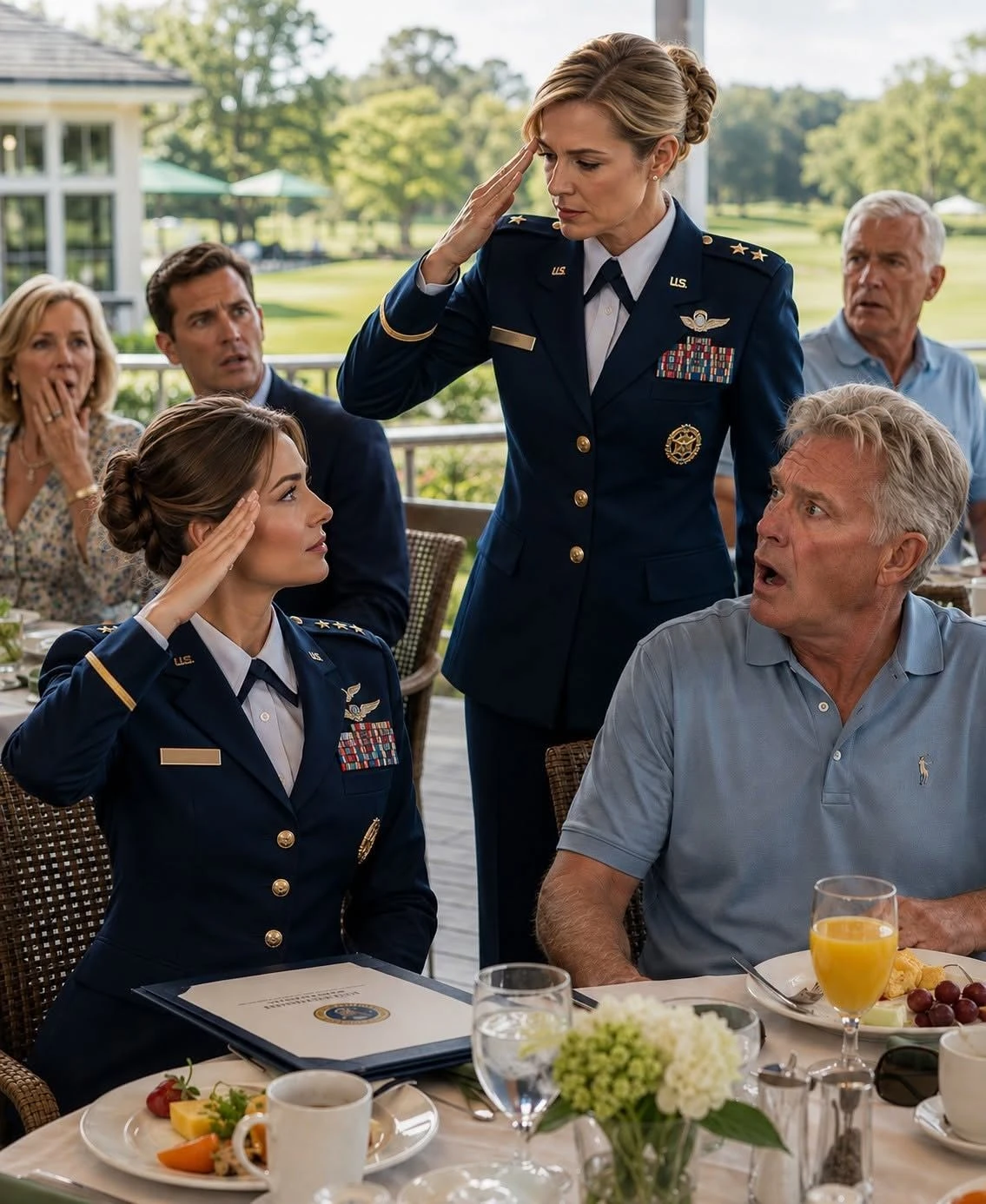
“I wouldn’t touch that, Gordon,” Frank Ellis murmured, his voice surprisingly quiet. He was looking at the security classification stamp. “That’s a federal felony just to look at the cover if you don’t have the clearance. Trust me.”
My father drew his hand back as if the paper had suddenly grown teeth. He looked up at me, his eyes searching my face for some sign of the compliant, quiet daughter who used to sit at the kids’ table during Thanksgiving.
“Claire,” he whispered, his voice stripped of its usual booming, country-club resonance. “What is this? What are they talking about? Orbital recovery? You’re a nurse. You’ve always been a nurse.”
“I am a nurse, Dad,” I said, finally looking him dead in the eye. “I hold a Master of Science in Nurse Anesthesia, a Doctorate in Acute Care Advanced Practice, and a Ph.D. in Aerospace Physiology from Johns Hopkins. I am a trauma flight surgeon. And for the last five years, I have been the chief medical officer for the Air Force Rapid Capabilities Office’s orbital recovery program.”
I leaned forward, placing my hands flat on the table.
“I don’t give flu shots. I perform microgravity thoracic surgery at two hundred and fifty miles above the Earth’s surface.”
The silence returned, deeper this time.
General Hale tapped the folder. “The *Aegis-IV* is experiencing a catastrophic environmental control failure, Colonel. We have three personnel on board. One of them is Mission Commander Marcus Vance—Director Vance’s son. He has suffered a decompression injury during an unscheduled extravehicular activity to repair the primary radiator array. He is currently unstable, showing symptoms of severe arterial gas embolism.”
My medical training took over instantly, the civilian surroundings of the country club fading into a distant, irrelevant blur.
“What’s his cabin pressure?” I asked, my voice snapping into the sharp, clinical cadence of an officer in command.
“Holding at 8.2 psi,” General Hale replied. “But they are losing nitrogen rapidly. They’ve initiated an emergency descent protocol, but the orbital dynamics mean they won’t clear the atmospheric interface for another four hours. If we don’t get a specialized medical asset into the recovery vector before they hit the lower atmosphere, the g-forces during deceleration will kill him.”
“Where is the recovery window?”
“The Pacific,” Hale said. “Two hundred miles off the coast of Southern California. We have an MC-130J Combat Talon II idling on the tarmac at Wright-Patterson right now. We fly to Edwards, transfer to the retrieval shuttle, and intercept them at fifty thousand feet.”
I stood up. The movement was fluid, practiced, and entirely devoid of the hesitation that had defined my childhood in this town. I reached down, picked up the classified folder, and tucked it securely under my arm.
“Claire,” my mother said, her voice trembling as she reached out a hand. “You’re… you’re leaving? Just like that? We haven’t even had our entrées.”
I looked down at her. I looked at Nathan, whose face was a mask of stunned humiliation. And finally, I looked at my father, Gordon Whitmore—the man who had spent thirty years telling anyone who would listen that his daughter was “just” a support piece to her brother’s corporate greatness.
“The country club will still be here when I get back, Mom,” I said softly. “But Commander Vance won’t be.”
I turned to General Hale. “Let’s go, General. We’re losing the window.”
As we walked away from the table, my boots clicking sharply against the stone tiles of the patio, I heard my father’s voice behind us, thin and desperate, asking a question to which he already knew the answer.
“Dennis… Frank… what the hell just happened?”
Frank Ellis didn’t answer him. He just watched my uniform vanish into the clubhouse corridor, his head shaking in slow, silent respect.
The black Chevrolet Suburban was waiting at the front entrance of the clubhouse, its engine idling with a low, heavy growl. Two security detail officers in civilian suits but carrying unmistakable tactical posture stood by the doors, their eyes scanning the country club parking lot with quiet, professional vigilance.
As General Hale and I approached, the rear door was thrown open.
I slid into the leather interior, the cool, air-conditioned air hitting my face like a splash of cold water. General Hale climbed in beside me, the heavy door shutting with a solid, pressurized thud that immediately cut off the sounds of the civilian world.
“Get us to Wright-Pat,” Hale ordered the driver. “Use the emergency lights. We have a cleared corridor on I-70.”
“Copy that, General,” the driver replied, pulling the vehicle out of the circular driveway with a smooth, aggressive surge of acceleration. Within seconds, the red and blue strobe lights hidden behind the vehicle’s grill began to flash, reflecting off the polished marble of the club’s facade as we left the gates of Briarwood behind.
I opened the manila folder on my lap.
> **TACTICAL MEDICAL ASSIGNMENT BRIEFING**
> * **Operation:** Blue Horizon / Recovery Phase VII
> * **Subject:** Commander Marcus Vance (USSF)
> * **Status:** Critical / Arterial Gas Embolism (AGE) / Microgravity Barotrauma
> * **Primary Asset:** Colonel Claire Whitmore (Flight Surgeon / Orbital Medicine)
> * **Transport:** MC-130J Combat Talon II (Tail #89-023) -> Edwards AFB -> Aegis Recovery Shuttle
“Walk me through the telemetry, General,” I said, my eyes scanning the medical readouts printed on the secure paper. “Why did Vance go EVA during a solar flare warning?”
“He didn’t have a choice,” Hale said, leaning forward to point at a high-resolution satellite capture of the *Aegis-IV* orbital vehicle. “A micro-meteoroid debris strike took out the primary coolant loop on the starboard radiator. The internal cabin temperature was rising by three degrees per minute. If they didn’t get the bypass valve open manually, the avionics would have melted within an hour. They would have lost altitude control and burned up over the Indian Ocean.”
“And the suit failed?”
“Micro-tear in the left shoulder joint during the repair,” Hale explained. “He experienced a rapid decompression from 14.7 psi to vacuum within four seconds before his automated seals could isolate the arm. He was exposed to vacuum for approximately eight seconds before he could scramble back into the airlock.”
I felt a cold knot tighten in my stomach. *Eight seconds in vacuum.*
The human body can survive it, but the physiological toll is catastrophic. The sudden drop in pressure causes the nitrogen dissolved in the blood to form bubbles—tiny, expanding pockets of gas that lodge themselves in the brain, the lungs, and the joints. It was the bends, but accelerated to a terrifying degree.
“He’s showing signs of focal neurological deficits,” I noted, pointing to the real-time biometric feed transmitted via the military’s secure satellite network. “Right-sided hemiparesis. Slurred speech prior to loss of consciousness. Cardiac rhythm is showing frequent premature ventricular contractions. He’s stroke-adjacent, General.”
“Can you stabilize him in transit?”
“In a standard medical transport? No,” I said honestly. “The moment the *Aegis* hits the upper atmosphere, the deceleration forces will spike to five or six Gs. With those nitrogen bubbles in his cerebral vasculature, the hydrostatic pressure will cause a massive hemorrhagic stroke. We have to repressurize him and initiate hyperbaric therapy *before* they exit the microgravity phase.”
“Which means you have to go up,” Hale said, her voice dropping to a serious, low whisper.
“Which means I have to jump,” I corrected her. “We use the *Valkyrie* high-altitude aerospace interceptor from Edwards. We match their trajectory at the edge of the stratosphere, dock with their recovery vehicle while they’re still in the high-altitude glide, and I perform the decompression procedure in the airlock.”
“It’s never been done during an active reentry, Claire,” Hale warned, using my first name for the first time. “The thermal load on the *Valkyrie* during the docking phase will be at the absolute limit of the airframe’s capability. If the docking seal fails at ninety thousand feet, you both vaporize.”
“Then we make sure the seal doesn’t fail,” I said, my voice steady. “Marcus Vance is thirty-two years old. He has a wife and a two-year-old daughter. I’m not letting him die because we were too timid to ride the lightning.”
Hale looked at me for a long moment, a faint, proud smile touching her lips. “Your father has no idea what you are, does he?”
“My father thinks success is measured by the size of your country club locker and how many people you can humiliate before lunch,” I said, closing the folder with a sharp snap. “He doesn’t understand that some of us prefer to measure it by how many lives we can pull back from the edge of the dark.”
The Suburban veered off the public highway, entering the restricted military transit road that led to the secure eastern gate of Wright-Patterson Air Force Base. The heavy steel barrier rose automatically as the guards recognized the general’s vehicle, and we swept onto the tarmac where the massive, grey silhouette of the MC-130J Combat Talon II was already waiting, its four turboprop engines screaming in the afternoon sun.
The flight from Ohio to California was a blur of noise, vibration, and high-intensity preparation.
Inside the cargo hold of the Combat Talon, the air was cold and tasted of hydraulic fluid and ozone. I had stripped out of my civilian blazer and silk blouse, replacing them with my custom-fitted flight suit—a multi-layered, pressurized garment constructed of Nomex, Kevlar, and an integrated liquid-cooling undergarment.
My flight surgeon gear was laid out on a steel table in the center of the cabin, secured by bungee cords to prevent it from sliding during the high-speed transit.
> **TACTICAL FLIGHT SURGEON EQUIPMENT CHECKLIST**
> * **Primary Tool:** Hyperbaric needle-decompression kit (custom titanium/zero-G rated).
> * **Medications:** Concentrated perfluorocarbon oxygen-carriers (Oxycyte), high-dose dexamethasone, heparin auto-injectors.
> * **Surgical Array:** Specialized microgravity suction-drainage system, magnetic surgical tool mat.
> * **Personal Gear:** HGU-55/P flight helmet with integrated heads-up display (HUD), oxygen mask with high-pressure regulator.
I was checking the seal on the hyperbaric syringe when the cabin door opened, and a tall, lean man in a flight suit walked in. He carried his helmet under his arm, his face weathered by years of high-G maneuvers and stratospheric flight.
Lieutenant Colonel Jack “Apex” Mercer. My pilot for the orbital intercept.
“Colonel Whitmore,” Jack said, extending a gloved hand. “I hear we’re going to go scratch the paint on the *Aegis* today.”
“Jack,” I said, shaking his hand firmly. “How’s the *Valkyrie* looking?”
“She’s prepped and green across the board,” Jack said, leaning over the table to look at the orbital tracking chart. “But the wind shear over the Pacific is getting nasty. We’ve got an atmospheric gravity wave rolling in off the coast. It’s creating pockets of severe turbulence between eighty and ninety-five thousand feet.”
“How does that affect our docking window?”
“It narrows it,” Jack said grimly. “Instead of a ten-minute stable docking window, we’re looking at about three minutes of relative stability before we hit the transition zone where the air gets thick enough to cause aerodynamic buffet. If we aren’t locked on by ninety thousand feet, the relative velocity differences will tear the docking collar right off my ship.”
“Then we do it on the first pass,” I said.
Jack laughed, a short, barking sound of genuine amusement. “I like you, Whitmore. You’ve got that high-altitude crazy in your blood. Most doctors would be throwing up in their oxygen masks right about now.”
“I did my residency in the trauma unit at Cook County in Chicago, Jack,” I said, sliding the titanium needles into my flight suit’s thigh pocket. “After dealing with gang warfare and holiday-weekend pileups, the vacuum of space feels remarkably civilized. At least nobody’s trying to shoot you while you’re trying to find a vein.”
“Fair point,” Jack said, his expression turning serious. “We have one more problem. Director Vance has just arrived at the command center at Edwards. He’s… frantic, Claire. He’s putting a lot of pressure on the launch control team to bypass the safety protocols.”
“Aaron Vance is an intelligence director,” I said, my voice hardening. “He treats operations like chess games. But his son isn’t a pawn. He’s my patient. You tell him that if he interferes with my pre-flight checklist, I’ll have General Hale bar him from the operations floor.”
Jack raised an eyebrow. “You’ve got brass ones, Colonel. I’ll give you that.”
“I didn’t survive the Air Force medical pipeline by letting men in suits tell me how to do my job, Jack,” I said, pulling the heavy flight helmet over my head and securing the chin strap. “Let’s go fly.”
The Combat Talon began its steep descent into the desert landscape of Edwards Air Force Base. Through the small porthole window, I could see the massive, sun-bleached expanse of the dry lake bed—the historic testing ground where humanity had first broken the sound barrier, and where we were about to attempt something far more dangerous.
The *Valkyrie-Class* aerospace interceptor was a beautiful, terrifying machine.
It sat on the secure pad at Edwards like a black arrowhead, its skin made of a specialized carbon-silicon matrix designed to withstand the four-thousand-degree heat of atmospheric reentry. It didn’t use standard jet engines; it was powered by a hybrid rocket-ramjet propulsion system that could propel it to Mach 6 within ninety seconds of launch.
I climbed into the rear cockpit, the heavy pressurized seal of my suit clicking into the survival seat’s interface.
The cockpit was tight, surrounded by digital screens displaying orbital trajectories, engine temperatures, and real-time medical telemetry from the *Aegis-IV*.
> **LAUNCH PROTOCOL STATUS**
> * **Vehicle:** Valkyrie Interceptor (Tail #09-001)
> * **Crew:** Lt. Col. Mercer (Pilot) / Col. Whitmore (Flight Surgeon)
> * **Target:** Aegis-IV Recovery Capsule (Trajectory Intercept: Vector 09-Alpha)
> * **Countdown:** T-minus 90 seconds
> * **Propulsion System:** Liquid Oxygen / Synthetic JP-10 (Green Status)
“Flight Surgeon, you are green for oxygen,” the launch control officer’s voice crackled through my helmet speakers. “General Hale sends her regards, Colonel. She says to tell your father you’re currently flying at forty thousand feet per minute.”
I smiled behind my gold-tinted visor. “Copy, Launch Control. Tell him I’m sorry I missed the dessert.”
“Thirty seconds, Claire,” Jack’s voice came from the front seat. “Hold onto your teeth. The initial kick on this baby is a bit of a ride.”
I closed my eyes for a single heartbeat, performing a mental scan of my body, checking my breathing, slowing my heart rate down to a steady sixty beats per minute. In this business, panic was the first indicator of mortality. You had to stay cold. Cold as the vacuum outside.
“Five… four… three… two… one… ignition.”
The world exploded.
It wasn’t a sound; it was an all-consuming, physical pressure that slammed against my chest like a concrete block. The *Valkyrie’s* twin rocket boosters ignited with three hundred thousand pounds of thrust, pinning me back into my seat as the g-forces spiked rapidly from 1G to 4.5Gs.
My vision began to narrow at the edges, a grey veil trying to pull down over my eyes as the blood was forced out of my brain toward my lower extremities. I initiated the G-strain maneuver—a rhythmic, guttural tensing of my thighs, abdomen, and chest muscles that forced the blood back up into my cerebral cortex.
*“Argh… squeeze… hold… breathe… squeeze… hold…”*
The digital altimeter on my HUD was spinning so fast the numbers were a blur.
*10,000 feet.*
*30,000 feet.*
*60,000 feet.*
The sky outside my canopy transitioned from the light, bright blue of the California desert to a deep, dark violet, and finally, into the absolute, star-speckled blackness of the upper atmosphere.
“Mach 4.2,” Jack’s voice gasped through the intercom, his own G-straining audible. “Engaging ramjets. Transitioning to cruise altitude.”
The violent vibration of the rocket boosters suddenly smoothed out into a high-pitched, metallic roar as the hybrid ramjets took over. The g-forces eased back to a comfortable 1.5Gs, allowing me to take a full, deep breath of pure oxygen.
“Target acquired,” Jack announced. “The *Aegis-IV* is dead ahead, thirty miles out, descending through one hundred and twenty thousand feet. Their velocity is Mach 5.8 and dropping.”
I looked through my canopy.
Far in the distance, a small, glowing orange spark was visible against the blackness of space—the plasma trail of the *Aegis-IV* capsule as it compressed the thin air of the upper atmosphere, turning the friction into a burning shield of fire.
We were chasing a shooting star. And we were going to catch it.
“One minute to intercept,” Jack’s voice was tense now, his hands making tiny, microscopic adjustments to the flight controls. “Claire, the turbulence is starting. The gravity wave is hitting us.”
The *Valkyrie* began to shudder, a violent, high-frequency vibration that made the digital screens in front of me jump and blur. It felt like driving a sports car over a gravel road at eighty miles an hour.
“I have the medical telemetry from *Aegis*,” I said, my fingers flying over my console. “Vance’s oxygen saturation is down to seventy-four percent. His heart rate is in ventricular tachycardia. He’s in cardiogenic shock, Jack. If we don’t dock in ninety seconds, we’re going to be recovering a corpse.”
“I’m on it! I’m on it!” Jack growled. “Engaging manual RCS thrusters.”
Through the front canopy, the *Aegis-IV* was now massive, a grey, cone-shaped vehicle covered in charred thermal tiles. The docking port at the rear of the capsule was spinning slowly, a mechanical ring of steel and copper that looked impossibly small against the vast expanse of the stratosphere.
“Matching roll rates,” Jack muttered.
The *Valkyrie* began to spin slowly, matching the rotation of the descending capsule. The earth below us—the curved, blue horizon of the Pacific Ocean—spun in a dizzying circle, a beautiful, silent backdrop to a high-stakes dance of death.
“Fifty feet,” Jack called out. “Thirty feet.”
“Turbulence spiking!” my HUD warned in a flashing red box.
A sudden, violent thermal updraft caught the *Valkyrie’s* left wing, throwing us upward and slightly to the right. The distance between the two craft closed with terrifying speed.
“Abort! Abort!” the launch control voice screamed in our ears.
“No!” I roared. “No abort! Jack, hold the line!”
Jack didn’t answer. He didn’t have the breath. He jammed the nose of the *Valkyrie* downward, using the reaction control thrusters to force the nose back into alignment.
*Clang.*
It was a heavy, metallic impact that reverberated through the entire frame of our ship, followed immediately by the high-pitched, screaming hiss of the automated docking seals engaging.
“Contact!” Jack shouted. “We have capture! Lock is green! Pressure is stabilizing!”
“I’m moving,” I said, unbuckling my harness before the lock sequence was even fully completed.
I grabbed my heavy trauma kit, my boots floating slightly in the microgravity environment of the high-altitude glide. I twisted the manual release valve on the rear bulkhead door, the air pressure between the two craft equalizing with a loud, wet gasp.
The hatch swung open, revealing the dark, crowded interior of the *Aegis-IV* cabin.
It smelled of burnt plastic, sweat, and the unmistakable, metallic scent of blood.
The cabin of the *Aegis-IV* was a disaster area.
Two astronauts, their faces pale and slick with sweat, were strapped into their seats, their hands frantically working the controls to maintain the descent trajectory. In the rear of the capsule, secured by thick nylon straps to the medical litter, lay Mission Commander Marcus Vance.
His flight suit had been cut open at the collar. His face was a sickening shade of grey-blue, his chest rising and falling in shallow, desperate gasps that sounded like a dry pump.
“Colonel Whitmore,” one of the astronauts gasped, not turning his head from the controls. “Thank God. He… he stopped breathing three minutes ago. We had to bag him.”
The second astronaut was holding a manual resuscitation bag over Vance’s mouth, forcing oxygen into his failing lungs.
“I’ve got him,” I said, sliding into the cramped space beside the litter. I locked my knees under the metal framework of the bulkheads to secure myself in the zero-G environment. “What’s his pupillary response?”
“Left eye is blown,” the astronaut replied, his voice shaking. “Fixed and dilated. He’s bleeding into his brain, Colonel.”
I reached into my kit, pulling out a small, handheld ultrasound scanner. I pressed the probe against Vance’s carotid artery. The screen instantly displayed the diagnostic image—a chaotic, pulsing mass of white bubbles blocking the blood flow to his cerebral cortex.
“Arterial gas embolism,” I muttered. “The nitrogen is acting like a solid plug. We have to bypass it.”
I grabbed the heavy, double-barreled hyperbaric needle from my kit. This wasn’t a standard medical procedure; it was a highly classified technique developed by the Air Force for deep-space survival.
“I’m going to perform an emergency carotid retrograde flush,” I announced. “I’m going to inject the perfluorocarbon oxygen-carrier directly into his brain through the jugular vein, while simultaneously venting the nitrogen gas through the carotid. It’s going to look violent. Don’t stop bagging him.”
“Understood, Colonel,” the astronaut said, his knuckles white around the manual bag.
I prepared the injection site, my hands moving with the absolute precision of a machine. Outside, the *Valkyrie* and the *Aegis-IV* were descending rapidly through eighty thousand feet, the friction of the thickening air beginning to shake the cabin with a deep, rumbling vibration.
“Thirty seconds to high-G entry, Claire!” Jack’s voice came through my helmet. “If you don’t have him stabilized before the deceleration hits, the hydrostatic pressure is going to blow his cerebral vessels!”
“I need twenty seconds!” I roared back.
I inserted the first titanium needle into the right jugular vein, the blood venting through the transparent tube into a specialized vacuum container. I immediately followed with the second needle, inserting it directly into the left carotid artery.
“Injecting Oxycyte,” I muttered, pressing the plunger of the primary syringe.
The white, oxygen-rich fluid surged into his neck, bypassing the blocked vessels and delivering critical oxygen directly to the dying brain cells.
Suddenly, a loud, wet *pop* sounded from the carotid line.
A thick stream of dark, frothy blood—filled with thousands of tiny, expanding nitrogen bubbles—blasted into the collection tube. It looked like shaken champagne.
Vance’s body suddenly convulsed, his arms thrashing against the straps, his eyes flying open. His right eye—the one that had been fixed and dilated—suddenly constricted, focusing on my face with a look of raw, terrified confusion.
“Hold him!” I shouted, holding the needles steady as the cabin began to vibrate violently.
“G-loading in five seconds!” Jack warned. “Four… three… two… one…”
The gravity returned with a brutal, crushing force.
The zero-G environment vanished instantly, replaced by a heavy, downward pull that spiked rapidly to 2Gs, then 4Gs, and finally, to a chest-crushing 5.8Gs as the capsule hit the dense layers of the lower stratosphere.
My body was slammed downward against the bulkhead, my ribs—reconstructed after a previous high-altitude incident—screaming in protest. But I didn’t let go of the needles. I kept my hands locked over Vance’s neck, my forearms absorbing the immense pressure of the G-load as the blood began to flow clean and clear through his carotid line, free of the nitrogen plugs.
“Pressure is holding,” I gasped, my vision graying out at the edges. “He’s… he’s clear.”
Vance’s breathing suddenly stabilized, the shallow, rattling gasps turning into a deep, rhythmic rise and fall of his chest. The monitors on his wrist began to display a steady, normal sinus rhythm.
The stroke had been averted. The brain was alive.
I fell back against the steel floor of the capsule, my body soaked in sweat, my chest heaving as the G-forces slowly began to decline, returning us to the gentle, floating glide of a successful atmospheric reentry.
“We did it,” the astronaut beside me whispered, his eyes filled with tears of pure relief. “You… you actually did it.”
I pulled my oxygen mask down, wiping a smear of blood and sweat from my forehead.
“Of course we did,” I said, a faint, weary smile touching my lips. “We’re the United States Air Force. We don’t lose people on my watch.”
The recovery pad at Edwards Air Force Base was a hive of activity.
Ambulances, fire trucks, and military command vehicles stood in a semi-circle around the blackened, smoking shape of the *Valkyrie* interceptor and the *Aegis-IV* capsule, which had landed on the dry lake bed beneath three massive, orange-and-white parachutes.
The rear hatch of the capsule was thrown open, the bright, hot California sun spilling into the cabin.
I stepped out first, my flight helmet resting on my arm, my uniform dirty but my posture straight.
A team of medical technicians rushed past me, their gurneys rolling over the cracked earth as they moved to extract Commander Vance and the crew. Behind them stood a tall, imposing man in a pristine three-piece suit.
Director Aaron Vance.
He didn’t look like an intelligence director right now. He looked like a father who had just spent the last four hours watching his only son’s life hang by a thread on a digital map.
He ran past the medical team, stopping beside the gurney as they wheeled Marcus out. His son was conscious, his eyes open, his hand reaching out to squeeze his father’s fingers.
“Marcus,” Aaron Vance whispered, his voice cracking as he fell to his knees beside the stretcher. “My God, Marcus.”
“I’m okay, Dad,” Marcus said, his voice weak but clear. “The… the Colonel. She got me. She cleared the line.”
Director Vance looked up. He looked at me, standing near the wing of the *Valkyrie*, my face smeared with grease, my flight wings catching the desert sun.
He stood up slowly, walked past the medical team, and stopped three feet in front of me.
For five seconds, the director of one of the most powerful intelligence agencies in the world didn’t say a word. Then, slowly, he reached up and extended his hand.
“Colonel Whitmore,” Vance said, his voice shaking slightly. “You saved my son’s life. The United States government owes you a debt that can never be repaid.”
“No debt, Director,” I said, shaking his hand firmly. “It’s my job.”
“Your father,” Vance said, a faint, curious look entering his eyes. “I know Gordon. I’ve worked with his firm on several national security contracts. He… he told me you were a nurse. At a local clinic.”
I let out a soft, wry laugh.
“My father has a very limited vocabulary, Director,” I said. “He only understands things that fit on a golf scorecard.”
“Well,” Vance said, a cold, dangerous glint entering his eyes—the look of a man who knew how to destroy careers with a single phone call. “I think it’s time we expanded his vocabulary.”
The flight back to Ohio was quiet.
I sat in the passenger cabin of a military Gulfstream C-37, the leather seats plush and comfortable compared to the cramped, vibrating interior of the *Valkyrie*. General Hale sat across from me, a glass of sparkling water in her hand, her eyes studying my face with quiet amusement.
“You’re not going to take the civilian assignment, are you?” she asked.
“The Pentagon?” I said, shaking my head. “No. Too many meetings. Too many people who want to discuss ‘synergy’ and ‘risk management’ instead of actually doing the work.”
“Your father called my office six times while you were in orbit,” Hale said, smiling. “He was trying to get his security clearance upgraded so he could see what was in that folder.”
See more on the next page
