Everything froze.
It was not a metaphor. It felt as though the atmospheric pressure in the room had dropped instantly to zero, freezing every molecule of sound, breath, and motion.
My mother went completely still. Her hands, which had been resting on Ethan’s shoulders, locked in place. The quiet, heartbreaking grief in her eyes vanished in a single microsecond, replaced by a terrifying, electric shock of pure comprehension.
Across the room, the guard’s head snapped up. “What did you say?”
Ethan started crying harder, his small frame trembling violently as he buried his face back into his mother’s orange jumpsuit. “I saw him… that night. It wasn’t Mom. I saw Uncle Victor.”
The air turned absolute ice.
Before my brain could process the syllables, before the shock could even translate into a scream, the heavy security door at the entrance of the visiting area banged open.
The warden strode in, flanked by two senior corrections officers, his face grim as he raised his hand sharply in the air.
“Stop the procedure!” the warden barked, his voice echoing off the concrete walls. “Hold all movement immediately!”
“Warden, we have clearance—” one of the junior guards started.
“I said hold!” the warden roared, his eyes darting directly toward our group. “We just received an emergency stay request from the state appellate clerk based on new verbal testimony under duress of execution. Bring the boy over here. Now.”
My mother didn’t let go of Ethan immediately. She held him for one long, fierce second longer, pressing him against her heart as if she were trying to graft him back into her own body, before gently setting him down. She looked up, her gaze cutting across the room like a drawn dagger, locking onto the open doorway behind us.
Because we weren’t alone in the building.
Uncle Victor Hayes had come along “to say goodbye.” He was waiting in the private administrative lobby just on the other side of the secure glass partition, sitting in one of the vinyl armchairs with a cup of prison-issue black coffee, playing the role of the devoted, grieving brother.
Or at least, he had been.
Through the wired glass window of the inner door, I saw him.
Victor’s face had completely drained of color. The warm, sorrowful paternal facade had vanished, stripped away in an instant like cheap wallpaper peeling off a damp wall. His jaw was slack, his eyes wide with a frantic, animalistic panic. In that single snapshot of time, he didn’t look like a loving uncle anymore. He looked cornered. He looked like a hunted beast.
Even as the guards moved toward the doorway to fetch him, Victor took a slow, deliberate step back. Then another. He angled his body toward the main exit doors that led out to the parking lot.
“Stop him!” my mother screamed—a sound so primal, so full of six years of buried rage, agony, and vindication that it rattled the bulletproof glass. “Don’t let him leave! He killed Arthur! He killed my husband!”
The chaos erupted like a powder keg.
Guards shouted commands, boots thudded against the linoleum, and the heavy steel alarms began to wail throughout the facility—a deafening, rhythmic klaxon signaling an internal security breach.
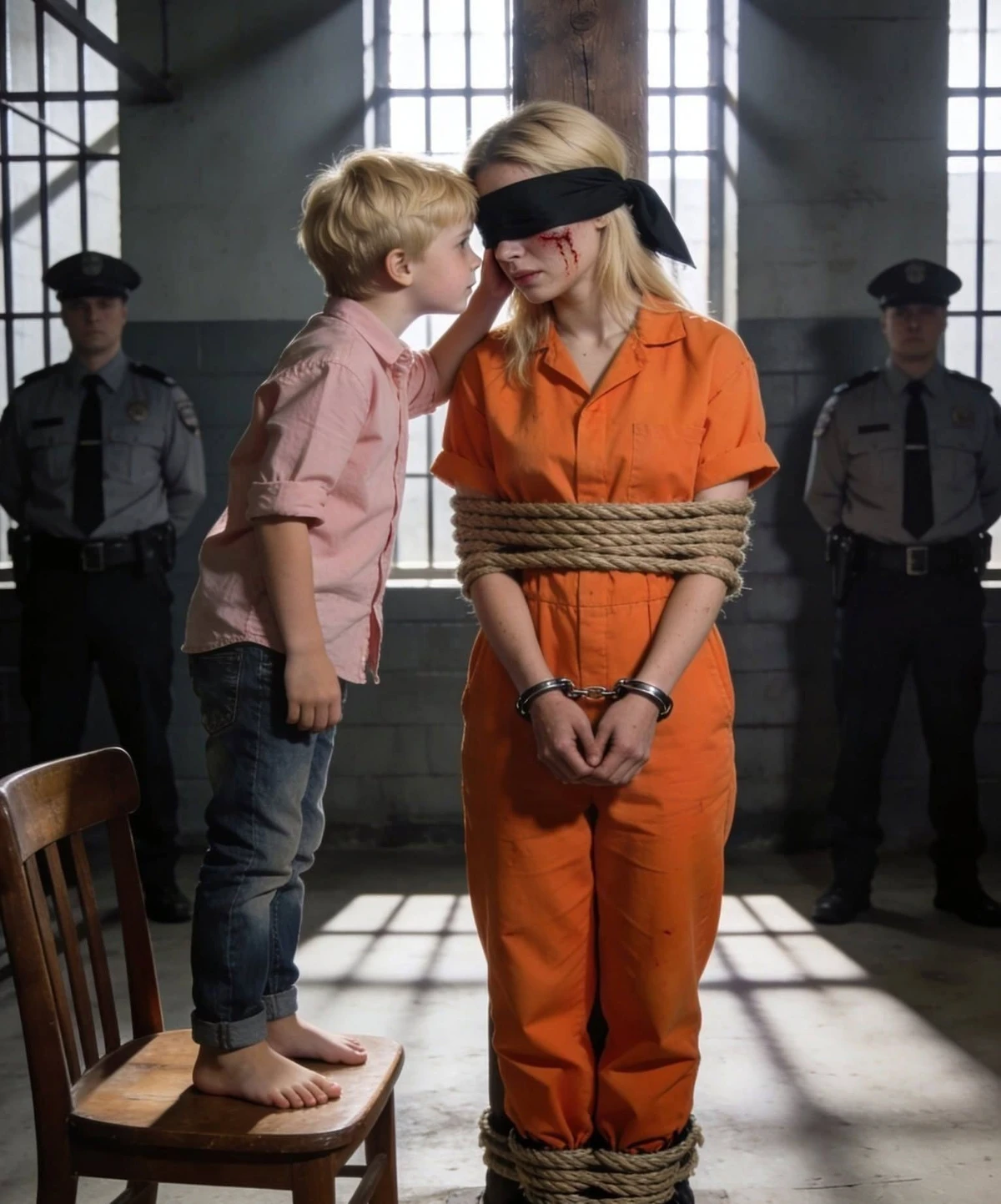
I stood paralyzed, my legs feeling like they were poured from wet cement. My mind spun into a chaotic vortex. Uncle Victor? No. That’s impossible. Victor was downstairs making coffee. Victor was the one who drove us here. Victor was the one who cried at my father’s funeral, who held my hand when I was drowning in grief…
“Clara!”
My mother’s voice cut through the alarm klaxons like a laser. She was standing now, tall and rigid despite the heavy chains around her waist, her eyes burning with a terrifying intensity.
“Clara, listen to me!” she shouted over the blaring sirens. “He framed me! Your uncle framed me! The night your father died… Victor was in the house. He had the key!”
The guards pushed past us, rushing toward the administrative lobby to intercept Victor Hayes. But it was already too late—or rather, the trap had already snapped shut.
Through the glass, we saw Victor bolt. He dropped his coffee cup, sending dark brown liquid splashing across the tiled floor, and sprinted toward the main exterior doors. But the facility’s lockdown protocol had already engaged. The heavy electromagnetic locks on all perimeter doors slammed shut with a thunderous bang.
Victor slammed his shoulder against the reinforced glass door, bouncing off it with a grunt of pain. He turned around, his chest heaving, his face contorted in a mask of wild, desperate fury, just as three armed guards tackled him to the ground.
As they pinned him face-down against the linoleum, forcing his arms behind his back in a brutal display of institutional force, Victor twisted his head sideways. His eyes didn’t meet the guards. They didn’t meet the warden.
They met mine.
Across the room, through the haze of dust and flashing red emergency lights, my uncle gave me a smile. It wasn’t a warm smile, nor was it a pleading one. It was a cold, jagged grin that chilled the marrow in my bones—a silent acknowledgment that the mask was gone, and the monster had finally stepped out into the light.
Part IV: Unraveling the Web – The Investigation Reopened
The days that followed were a surreal blur of flashing media vans, frantic legal maneuvers, closed-door grand jury hearings, and a city in complete ideological shock.
The local newspaper headlines read like psychological horror fiction:
“STAY OF EXECUTION: Convicted Mother Spared Five Minutes Before Lethal Injection as Eight-Year-Old Son Accuses Brother-in-Law.”
“THE HAYES FILE REOPENED: How a Grief-Stricken Uncle Concealed Six Years of Murder.”
Caroline Hayes was released from maximum security under an emergency judicial order pending a full evidentiary hearing and a motion to vacate her conviction. The release wasn’t cinematic or graceful; there were no balloons or cheering crowds outside the prison gates. Just a damp Tuesday afternoon, a gray drizzle falling from an overcast sky, and the heavy iron gates sliding open to release a woman who had spent two thousand one hundred and ninety days staring at a concrete wall waiting for the state to end her life.
When she walked out, she looked less like a person and more like an apparition—a skeleton draped in oversized civilian clothes provided by the public defender’s office.
Ethan and I were waiting by the curb.
I didn’t run to her at first. My feet felt glued to the wet asphalt, the weight of six years of cowardly silence pressing down on my shoulders like a lead vest. I had doubted her. I had let the world convince me that my own mother was a cold-blooded killer.
Mom stopped a few feet away. She looked at me, her hazel eyes glistening with unshed tears, and then she opened her arms.
I broke. I stumbled forward, crashing into her embrace, sobbing so hard my ribs ached.
“I’m sorry,” I choked out into her shoulder, the words tearing through my throat. “I’m so sorry, Mom. I didn’t believe you. I let them tell me—I let myself think—”
“Hush, sweetheart,” she whispered, holding me so tightly I could feel the sharp ridge of her collarbone against my cheek. “You were a child. They built a cage out of lies so heavy even I almost believed I was trapped in it. But we’re out now. We’re out.”
Ethan squeezed in between us, wrapping his small arms around both our waists, completing a circle that had been brutally broken six years ago.
With Caroline out, the state’s investigative machinery, spurred by relentless public scrutiny and the sudden, undeniable confession of an eyewitness, tore into Victor Hayes’s life with a ferocity that left nothing standing.
What they uncovered was a masterclass in deception, greed, and cold, calculated malice.
Two nights before my father’s murder, Arthur and Victor Hayes had a violent, unrecorded confrontation in the study of our home. My father, who managed the family’s agricultural equipment business, had discovered a massive financial discrepancy—over eight hundred thousand dollars embezzled from corporate accounts over a five-year period.
Victor had been systematically bleeding the company dry to fund high-stakes underground gambling debts and a lavish lifestyle with a secret mistress in a neighboring county.
When Arthur threatened to go to the police and cut him off completely, Victor didn’t panic. He planned.
On the night of the murder, Victor used his own spare key—a relic from when he used to housesit during our family vacations—to slip into the house quietly through the back mudroom while everyone was asleep. He walked into my parents’ bedroom, where my mother lay in a deep, medically induced sleep (she had taken a mild prescription sleeping pill that evening for chronic migraines).
Using a kitchen knife he had retrieved from downstairs, Victor murdered his own brother with ruthless efficiency. Then, in a stroke of chilling psychological warfare, he wiped his own prints clean, took my mother’s hand while she was fast asleep, and deliberately pressed her fingers around the textured handle of the blade before sliding it deep under her bed. He even wiped a microscopic smear of blood onto the hem of her silk robe as he stepped out of the room.
He had counted on the police taking the path of least resistance. He had counted on the circumstantial evidence being so overwhelming that no jury would look any further. And most of all, he had counted on silence.
For six years, Victor had played the role of the devoted, self-sacrificing uncle with chilling perfection. He funded the legal defense teams just enough to look supportive, while quietly ensuring that none of the private investigators dug too deeply into his own financial records. He sat in our living room, ate our food, patted Ethan on the head, and looked us in the eye with a smile while carrying the secret of his brother’s blood on his hands.
And he would have gotten away with it—clean, untouchable, and wealthy—if not for an eight-year-old boy who couldn’t sleep.
Part V: Confrontation and Justice
See more on the next page
