My Marine brother thought it would be funny to humiliate me in front of his entire unit on Family Day.
He laughed at my “cute little call sign,” tossed my visitor badge into the dirt, and demanded I prove I had ever done anything meaningful. Then I said two words—“FURY TEN.” The laughter stopped instantly,
and his Gunnery Sergeant looked at me as if he had just seen a ghost step out of a classified file.
My name is Eleanor Hayes, and for most of my life, my brother Tyler Hayes believed he was the hero of every story.
The scene unfolded at Camp Pendleton, California, beneath a blazing afternoon sun.
The air smelled of diesel fuel, hot asphalt, ocean salt, and freshly cut grass. American flags snapped sharply in the wind while families wandered between armored vehicle displays and food tents.
It was Family Day.
A day for pride.
A day for photos.
A day for parents to admire the uniforms their children had earned.
My mother had practically begged me to attend.
“Please, Ellie,” she said over the phone. “Your brother wants the family there.”
I almost laughed.
Tyler never wanted family.
He wanted an audience.
He wanted our father clapping proudly.
He wanted relatives posting photos online with captions like Our Hero.
And most of all, he wanted me there because embarrassing me had always been one of his favorite hobbies.
I arrived wearing jeans, a white button-down shirt, sunglasses, and a lightweight navy blazer.
No medals.
No uniform.
No hints.
That was intentional.
When Tyler spotted me, his grin appeared immediately.
“Well, look who showed up,” he called out. “The ghost of the Hayes family.”
My mother sighed.
“Tyler…”
He ignored her.
“Careful where you wander, Ellie. They don’t let random office workers into restricted areas.”
A few younger Marines laughed.
My father looked down awkwardly.
I stayed silent.
That annoyed Tyler.
It always did.
People like him needed reactions.
Needed proof their words landed.
So he kept pushing.
We walked past displays of radios, tactical gear, and military equipment while children climbed onto armored vehicles for photographs.
Then Tyler stepped in front of me again.
“You know what’s funny, Gunny?” he said to the man standing nearby. “My sister disappeared for years and came back acting mysterious.”
The Gunnery Sergeant, Marcus Reed, didn’t respond.
His eyes remained fixed on me.
Tyler continued anyway.
“Mom thinks she works for the government.”
A few Marines chuckled.
“Probably pushing paperwork somewhere.”
My mother lowered her voice.
“Please stop.”
But Tyler was enjoying himself too much.
“Come on, Ellie. Tell everyone what you do.”
I removed my sunglasses slowly.
“Tyler,” I said quietly. “Not here.”
His smile widened.
To him, that sounded like fear.
“Oh no. This is exactly the place.”
He spread his arms dramatically.
“We’re surrounded by real service members. Real deployments. Real call signs.”
The word real hung heavily in the air.
He had no idea how many memories that word carried.
No idea how many nights I’d spent listening to coordinates crackle through radios.
No idea how many names I still remembered.
No idea what had happened during the years I never discussed.
Then Tyler reached over and flicked my visitor badge.
The clip snapped loose.
The badge landed in the gravel.
Several people laughed.
I looked down.
Picked it up.
Brushed away the dust.
Then I looked directly at him.
“What was your call sign again?” he asked mockingly.
A few Marines leaned closer.
Even the families nearby seemed to pause.
I glanced briefly toward Gunnery Sergeant Reed.
Then I answered.
“FURY TEN.”
The effect was immediate.
The laughter died.
Completely.
Marcus Reed’s face lost all color.
Not pale.
White.
The expression on his face wasn’t confusion.
It was recognition.
Several older Marines exchanged glances.
One actually straightened his posture.
Tyler frowned.
“What?”
Nobody answered.
The wind seemed louder suddenly.
Flags snapped overhead.
Tyler laughed nervously.
“Seriously? That’s it?”
Still no response.
Then Gunnery Sergeant Reed took one slow step forward.
His eyes never left mine.
And when he finally spoke, his voice sounded very different from before.
“Ma’am…”
The single word sent a chill through the crowd.
May you like
- Before Going to Bed, Unplug These Kitchen Appliances to Reduce the Risk of an Electrical Fire
- 5 Clothing Colors to Avoid After 50 — and How to Keep Your Natural Glow
- Seniors: Should You Add a Mineral to Your Water for Better Blood Circulation?
- Why You Should Hang Eggshells in Your Garden: A Simple Trick Every Gardener Should Know
- The Simple Home Remedy for Wrinkles and Dark Spots on Hands and Arms
The word *Ma’am* did not merely cut through the salt-heavy air of Camp Pendleton; it dropped like an unexploded five-hundred-pound ordnance onto the sunbaked gravel between my boots and Gunnery Sergeant Marcus Reed’s spit-shined Corcorans.
The ocean breeze, gusting off the Pacific bluffs with the sharp bite of kelp and diesel exhaust, whipped the red-and-gold Marine Corps guidon above the 1st Reconnaissance Battalion display. The heavy nylon snapped with a sound like a rifle crack.
Nobody moved.
In the second row behind my brother, two senior staff sergeants—men with weathered faces, triple-stacked combat ribbon bars, and the unmistakable, dead-eyed stillness of combat veterans who had survived the Euphrates drainage canals—instinctively snapped their heels together.
*CLACK.*
The sound of their leather soles striking the asphalt was mechanical, involuntary, and absolute.
Tyler’s nervous, high-pitched chuckle withered in his throat. The smug, golden-boy grin that had defined his face since our high school football days in San Diego didn’t just fade; it disintegrated into an ugly, slack-jawed mask of confusion. His hands, resting arrogantly on his web belt, began to twitch against the brass buckle.
“Gunny?” Tyler muttered, stepping sideways, his voice dropping into a desperate, patronizing register that sounded paper-thin against the roaring silence. “Gunny, what are you doing? It’s just Ellie. My sister. She’s messing with you. She probably read some call sign off a military history forum or overheard it at an airport bar—”
“Lance Corporal Hayes,” Gunnery Sergeant Reed spoke.
The voice was not loud. It didn’t carry the theatrical parade-ground roar that non-commissioned officers used to terrify recruits at MCRD San Diego. It had the subterranean, bone-grinding density of a hydraulic press.
Reed didn’t turn his head. He didn’t blink. His dark, sun-scorched eyes—webbed with shrapnel scars across the left cheekbone—remained locked onto mine with an intensity that bordered on religious shock.
“Shut your mouth,” Reed commanded softly. “Stand at attention. And do not draw another breath until you are given permission.”
Tyler froze.
The color drained from his neck first, tracking upward through his cheeks until his skin turned the translucent, sickly shade of spoiled milk. A Marine lance corporal did not get told to shut up in front of four hundred civilians, his parents, and the battalion command element unless a fatal line had been crossed.
My mother, Beatrice Hayes, took half a step forward, her pastel floral cardigan fluttering in the coastal wind, her diamond rings catching the California glare:
“Excuse me, Sergeant,” my mother said, forcing that sharp, country-club laugh she used whenever a waiter brought the wrong vintage of chardonnay. “I think there’s a misunderstanding. Tyler is the Marine here. Eleanor works in administrative consulting. If she’s said something inappropriate or stolen some military phrase, I assure you she didn’t mean to disrespect your unit—”
“Mrs. Hayes,” Reed interrupted, his tone chilling the air by ten degrees. “Step back behind the white line.”
My father, Richard Hayes, reached out and grabbed my mother’s arm, pulling her back. For thirty years, my father had run a commercial shipping logistics firm out of the Port of Long Beach. He had spent his entire life bragging about Tyler’s junior varsity touchdowns, Tyler’s enlistment, Tyler’s rifle qualification scores, while treating my quiet departures and unmarked government paychecks as a family embarrassment.
Now, my father’s hand was shaking so violently that his grip slipped against my mother’s sweater.
Gunnery Sergeant Reed took two slow, measured steps toward where I stood in the gravel.
He stopped exactly forty inches from the tips of my boots.
The veteran Marine—a man who had survived two tours in the Helmand Province, an ambush in Sangin, and a classified interdiction in the Gulf of Aden—brought his right hand up to the brim of his pristine service cover in a crisp, razor-sharp, trembling salute:
“October 14, 2021,” Reed whispered, his vocal cords tearing across the syllables like dry slate. “Grid Coordinate: *Delta-Two-Niner-Eight*. The Shok Valley crevasse. Extraction callsign: *Hammer Three*.”
Reed’s eyes filled with a sudden, glassy sheen of unshed tears that horrified the younger Marines watching from the armored vehicle displays:
“We were pinned beneath thirty-caliber heavy machine gun fire from three reinforced ridgelines. The JTAC was dead. The platoon commander had lost both legs to an improvised mine. We had eleven critical casualties, two tourniquets left, and fifty rounds of five-five-six per man.”
Reed swallowed, his chest hitching behind his pristine uniform blouse:
“Every fast-mover pilot in the theater aborted the ingress because the cloud ceiling was sitting eighty feet off the deck and the canyon was narrower than the wingspan of an F/A-18.”
Reed looked dead into my eyes:
“And then an unflagged, low-observable A-10C Thunderbolt broke through the fog at two hundred feet.”
“No wingman.”
“No radar escort.”
“The pilot flew inverted through a blind mountain gorge, took seventy rounds of armor-piercing anti-aircraft fire through her starboard engine cowlings, and manually laid three thousand rounds of thirty-millimeter depleted uranium across the enemy bunkers less than fifteen yards from our perimeter trench.”
Reed’s voice dropped into an awe-struck, suffocating whisper:
“That pilot stayed on station for forty-two minutes until the rescue birds touched down.”
“When the radio net asked who cleared the sky…”
Reed’s hand remained locked at his brow:
“…the voice that answered through the static said: *’FURY TEN. The lane is green. Bring the boys home.’*”
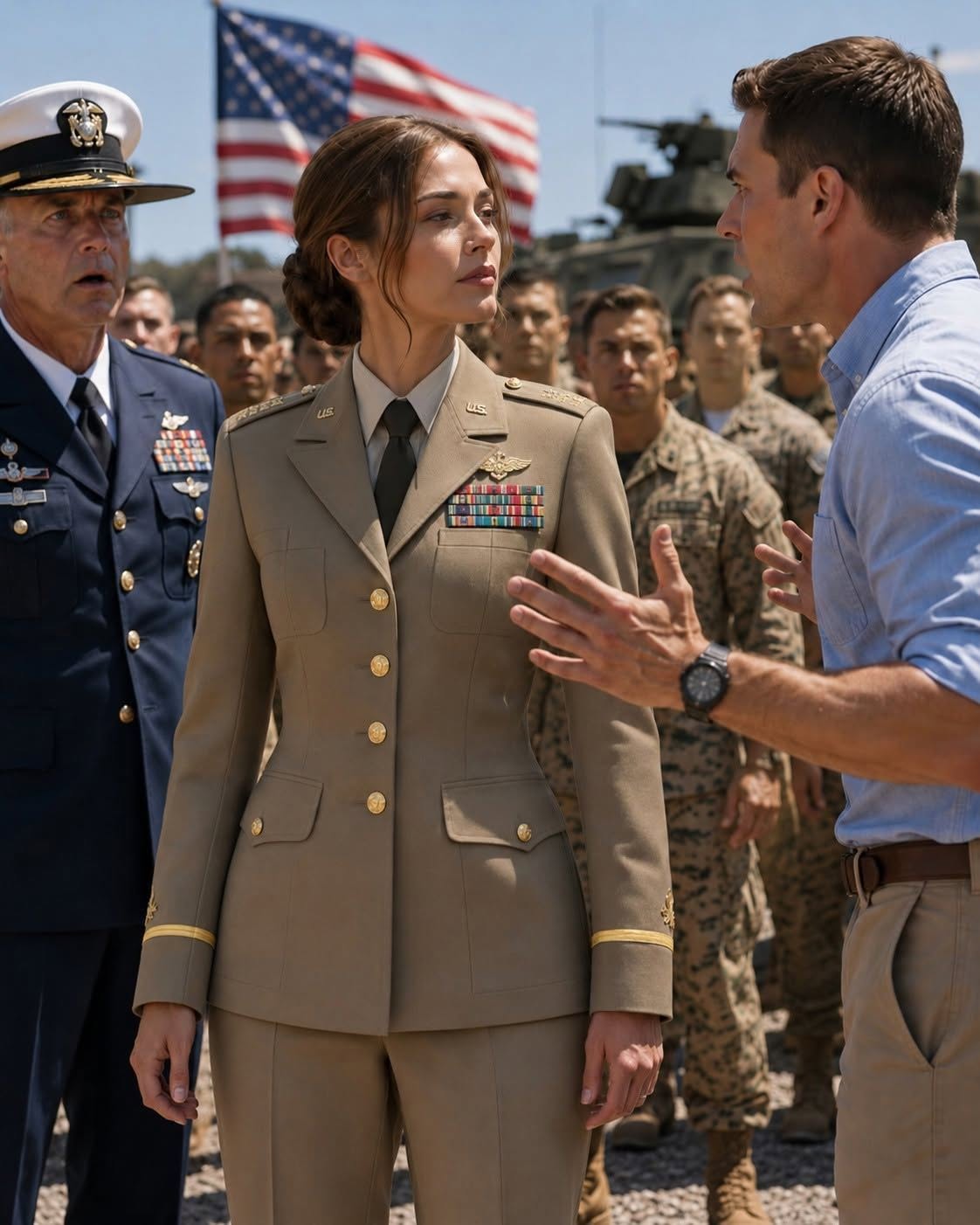
The entire courtyard of the 1st Reconnaissance Battalion went so utterly, terrifyingly silent that the faint hum of a diesel generator two hundred yards away sounded like an incoming artillery shell.
Tyler stood in rigid, paralyzed attention.
His eyes darted frantically between Reed’s trembling salute and my plain white button-down shirt. His chest heaved in rapid, shallow hitches; his fingers dug into the seams of his utility trousers with enough force to turn his knuckles purple.
“Gunny…” Tyler stammered, tears of sheer, unadulterated humiliation suddenly welling in the corners of his eyes. “That… that’s a fairy tale. That was an Air Force pilot. A fighter pilot! My sister… Ellie is five-foot-six! She drives a ten-year-old Subaru! She lives in an apartment in Alexandria!”
I didn’t shout.
I didn’t drop my gaze.
I slowly reached into the left interior breast pocket of my lightweight navy blazer.
Tyler flinched, taking half a step backward as if expecting a weapon.
I pulled out a small, heavy, rectangular object wrapped in black carbon-fiber cloth. I untied the waxed Kevlar twine and allowed the fabric to fall away into the dust.
Resting in the palm of my hand was an unsealed, four-sided titanium cryptographic keycard stamped with the raised golden seal of the **United States Air Force Special Operations Command** and the **Defense Advanced Research Projects Agency**:
“`
# ==================================================================
UNITED STATES AIR FORCE // SPECIAL ACTIVITIES SQUADRON
CALLSIGN: ‘FURY TEN’ // TACTICAL AIR INTERDICTION
# OFFICER IDENTIFIER: MAJOR ELEANOR R. HAYES, USAF
FLIGHT STATUS: COMMAND PILOT // COMBAT EVALUATION DIVISION
HOURS LOGGED: 3,420 (A-10C, F-15E, LOW-OBSERVABLE AIR SYSTEMS)
DECORATIONS: AIR FORCE CROSS, SILVER STAR, PURPLE HEART W/ GOLD STAR
SECURITY MANDATE: TITLE 10 // SPECIAL ACCESS REQUIRED (TS/SCI)
“`
Beside the titanium credential, pinned to the black carbon cloth, was the single, scarred, blackened piece of titanium shrapnel I had extracted from my own left shoulder blade after landing *Fury Ten* on a burning runway at Bagram Airfield with one engine blown off its mount.
Gunnery Sergeant Reed stared at the titanium credential.
The fifty-two-year-old Marine non-commissioned officer dropped his salute, stepped forward, and slowly lowered his head in a gesture of profound, battlefield reverence:
“Major Hayes,” Reed spoke, his voice carrying to every Marine, every spouse, and every officer standing within fifty yards. “It is an honor to breathe the same air as you, ma’am.”
From the edge of the display area, three field-grade officers who had been observing the incident stepped through the crowd.
Walking at the front was **Lieutenant Colonel James Callahan**, Commanding Officer of the 1st Reconnaissance Battalion, flanked by his Executive Officer and the Battalion Sergeant Major.
Callahan’s eyes locked onto the titanium keycard in my palm.
*CLACK.*
Callahan brought his heels together, snapping an immaculate, four-finger salute to the brim of his cover:
“Major Hayes. We were notified by the Pentagon’s Defense Logistics Security Directorate that an evaluator from Task Force Iron Sentinel was on base. We had no idea you were Lance Corporal Hayes’s sister.”
“Lieutenant Colonel Callahan,” I replied, my voice smooth, cold, and level as a runway centerline. “At ease.”
Callahan dropped his hand, turning his flint-gray eyes onto Tyler.
The look the battalion commander gave my brother was not the proud, paternal gaze Tyler had spent weeks bragging about to our parents. It was the look a surgeon gives an infected appendix before slicing it out of the body.
“Lance Corporal Hayes,” Callahan said with lethal clarity.
“Sir!” Tyler choked out, his vocal cords tearing.
“You have disgraced the uniform of the United States Marine Corps in front of civilian dependents, your chain of command, and a decorated combat aviator who saved the lives of your own battalion’s senior leadership before you ever set foot on the yellow footprints at boot camp.”
Callahan pointed an iron finger toward the battalion guardhouse:
“Surrender your identification card to the Sergeant Major.”
“Report to the duty desk in full service alphas within fifteen minutes.”
“You are relieved of all Family Day privileges, placed on immediate administrative restriction, and your recommendation for promotion to Corporal is hereby revoked with permanent prejudice.”
Tyler let out a strange, high-pitched, strangled squeak from the back of his throat.
He looked at our mother.
He looked at our father.
Neither of them moved. My mother stood clutching her cardigan, her mouth frozen open, staring at me as if I were a ghost that had stepped out of a burning aircraft. My father stared down at the dirt, unable to lift his eyes to meet the gaze of the battalion commander he had tried to impress with his commercial shipping stories.
“Sergeant Major,” Callahan commanded. “Escort the Lance Corporal off the parade deck.”
“Aye, sir,” the Sergeant Major barked, grabbing Tyler by the shoulder harness of his uniform, shoving the weeping, trembling twenty-two-year-old Marine toward the battalion administrative building.
As Tyler’s boots dragged through the dust, he turned his head back through the blazing California sun, crying out toward me in raw, suffocating humiliation:
“ELLIE! PLEASE! TELL HIM! TELL THE COLONEL I’M YOUR BROTHER!”
I didn’t answer him.
I looked at Lieutenant Colonel Callahan.
“Colonel Callahan,” I said softly.
“Major?”
“The Family Day demonstration was educational.”
I tucked the titanium credential back into my blazer:
“Now take me to the Sensitive Compartmented Information Facility. We have an operational emergency in the deep water.”
Ten minutes later, we were inside the subterranean, blast-hardened command bunker beneath the **Del Mar Tactical Communications Annex at Camp Pendleton**.
The air on Sub-Level Four was chilled to forty-one degrees to preserve the massive cryogenic supercomputing arrays routing satellite telemetry for the **I Marine Expeditionary Force (I MEF)** and the **United States Third Fleet**.
The room was walled with sixty-inch digital presentation monitors displaying live global maritime traffic, real-time infrared drone sweeps, and encrypted satellite communication intercepts.
Standing around the central holographic planning table were eight senior officers: two Navy captains, three Marine colonels, and **Major General Raymond Sterling**, Deputy Commander of Marine Corps Installations West.
Beside the planning table sat **United States Deputy Attorney General Marcus Hayes**, his ruggedized Panasonic Toughbook slaved directly to the SPY-6 air-and-missile defense radar array of the guided-missile destroyer **USS *Arleigh Burke* (DDG-51)**, which was cutting through the outer approaches of San Diego Bay at thirty-two knots.
When Lieutenant Colonel Callahan and I stepped through the heavy pneumatic blast doors, every officer in the room came to immediate, synchronized attention.
*CLACK.*
“Major Hayes,” Major General Sterling spoke, his face drawn tight in lines of grave, unyielding operational tension. “Thank you for breaking cover on the parade ground. We wouldn’t have authorized the reveal if your family’s logistics network hadn’t just tripped our Tier-One interdiction tripwires.”
“At ease, General,” I said, stepping to the head of the holographic table, resting my knuckles against the glass console. “Give me the tactical picture.”
General Sterling tapped the center touchscreen.
The holographic display flared to life in brilliant, crystalline 3D wireframe resolution:
“`
See more on the next page
